
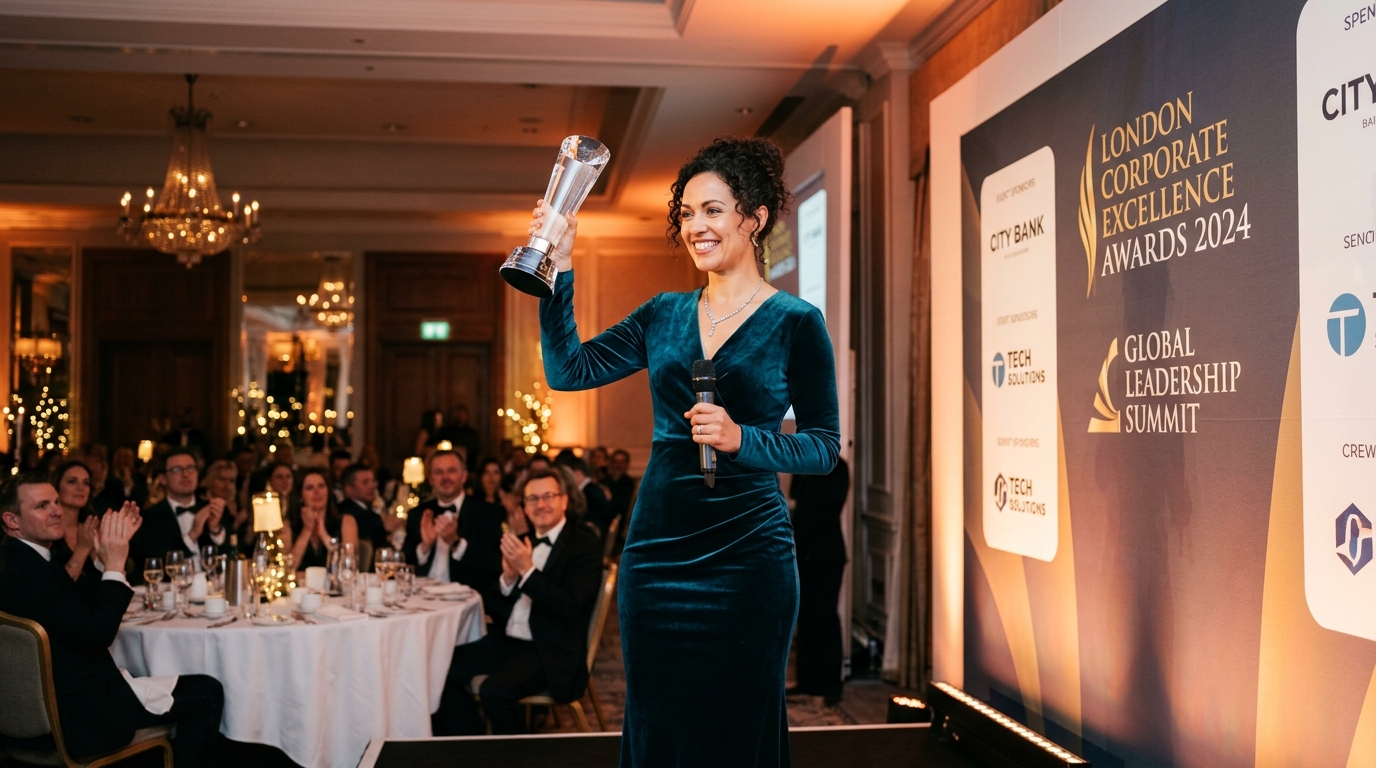
The most common thing I hear from clients after an awards evening is that the images are great but they are not sure what to do with most of them. They post the group shot, they send the trophy handover to each winner, and then the rest of the library sits in a folder until someone needs it for something specific. That is not a photography problem. That is a strategy problem. And it starts well before the evening itself.
Getting the most from your awards night photography is not about having the best photographer in the room, though that helps. It is about knowing what you want the images to do before the event takes place, communicating that clearly, and having a plan for how the library gets used in the days and weeks that follow. This guide covers exactly how to do that at every stage of the process.
Before the Event: The Decisions That Determine the Quality of the Library

In my experience, the quality of an awards photography library is almost entirely determined in the two weeks before the evening, not on the night itself. The clients who walk away with a library they use for months are the ones who made clear decisions in advance. The ones who are disappointed are almost always those who left everything to be worked out on the day.
As Bernardson Photography’s guide to pre-event strategy for corporate photography1 confirms, the most commercially effective awards photography commissions begin with a structured pre-event planning process that establishes clear objectives, a comprehensive brief, and agreed deliverables before a single image is taken. The specific decisions to make before your awards evening include:
Define what the images need to do
Before you write a brief, answer this question: what does the photography from this event need to achieve? If the primary purpose is sponsor reporting, the brief prioritizes sponsor visibility across every image type. If the primary purpose is internal employee recognition, the brief prioritizes genuine individual and group moments that communicate how the organization values its people. If the primary purpose is press and PR, the brief prioritizes clean, high-contrast images that work at thumbnail size in an online publication. Most awards night photography serves all three of these purposes to some degree, but knowing which is primary changes every creative and logistical decision that follows.
Share winner information in advance where possible
This is the single most impactful piece of information a client can give an awards photographer before the evening. Knowing which table each winner is sitting at before their category is called allows the photographer to position themselves to capture both the winner’s table reaction and the stage moment without having to choose between them. I have covered evenings where I knew every winner in advance and the difference in the quality of the announcement shots compared to evenings where I did not was significant. If winners are confidential until the ceremony, even knowing which tables the shortlisted nominees are sitting at helps.
Agree the deliverable format and timeline before the evening
How many edited images do you expect? In what format? By what deadline? If you need a selection of images for a press release the following morning, the photographer needs to know this before the event so they can flag and process those images immediately after the ceremony. If you need full-resolution files for print use as well as web-optimized versions for digital channels, agree both at briefing stage. If sponsors have specific deliverable requirements, these should be in the brief rather than communicated after delivery when it is too late to address gaps.
On the Night: How to Support Your Photographer for Better Results
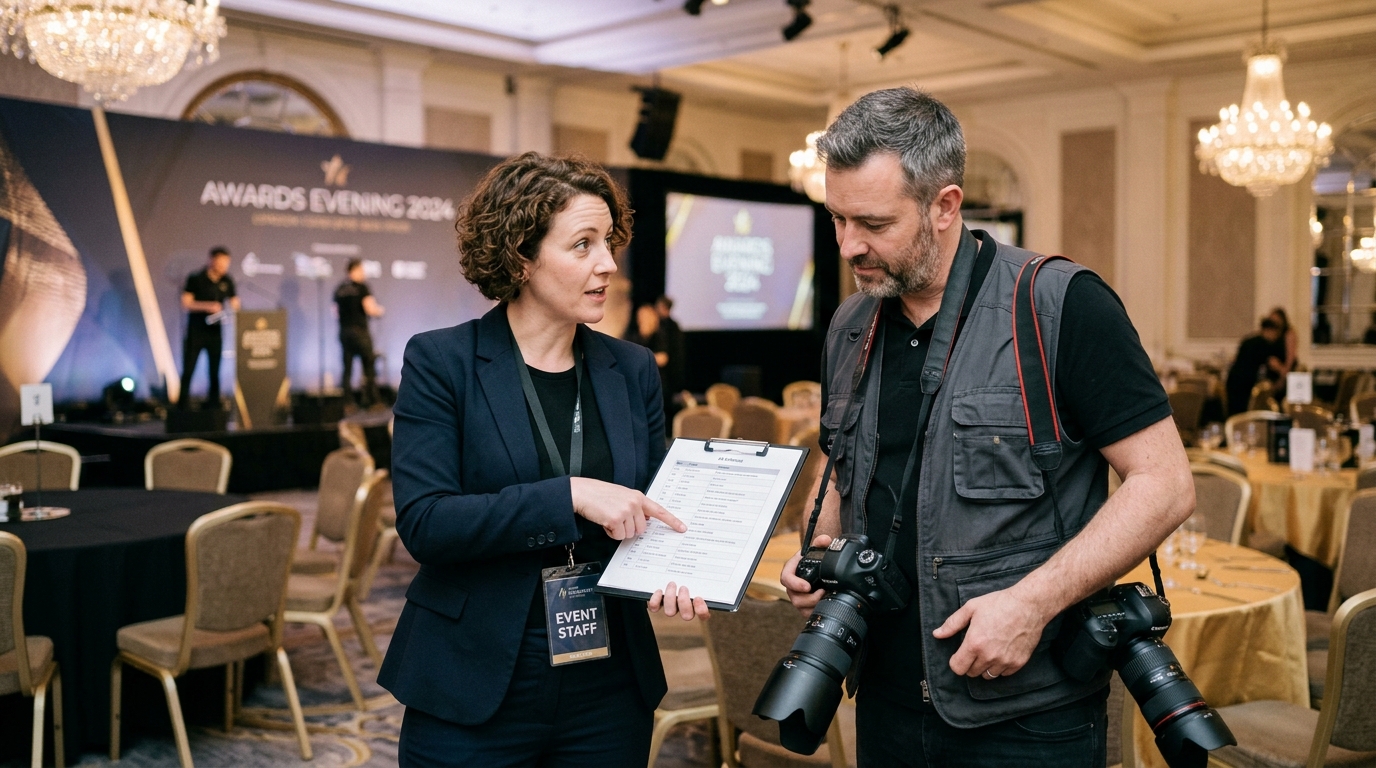
The night itself is where most event organisers think their job is done and the photographer takes over entirely. In practice, the most successful awards evenings I have worked on have always had one person whose specific role on the night was to communicate with me in real time. Not to manage me. Just to keep me informed.
As Social Tables’ guide to on-site photographer coordination for awards events identifies, the organizations that consistently get the strongest results from their awards photography are those that treat the on-site photographer relationship as an active collaboration rather than a passive commission. The specific ways an event team can support the photographer during an awards evening to produce better results include:
- Assign a named on-site contact before the evening begins. This person has the photographer’s mobile number and is available throughout the evening to communicate any changes to the running order, flag when a VIP or key winner arrives, and make real-time decisions if the photographer needs guidance on priorities. In my experience, this single element makes more difference to the quality of an awards photography library than almost anything else the client controls on the day.
- Introduce the photographer to key individuals during the drinks reception. If there are winners, sponsors, or executives who need individual portraits as part of the deliverable, introducing the photographer to those individuals during the reception ensures those portraits are captured informally and naturally rather than through an awkward formal request during the dinner.
- Keep the photographer informed of running order changes. Awards evenings rarely run exactly to time. If a category is moved, a speaker runs long, or an unscheduled moment arises, a quick message to the photographer ensures they are in the right place rather than discovering the change after the fact.
- Confirm the group photograph timing before the ceremony begins. The group photograph requires the cooperation of multiple individuals and a clear position on the stage. Agreeing the timing before the first category is called, and having someone prepared to gather the relevant individuals at that moment, means the photograph happens efficiently rather than becoming a logistical challenge at the end of a long evening.
- Tell the photographer when early-departure guests need their portrait. If a VIP, a sponsor representative, or a winner needs to leave before the end of the evening, flag this to the photographer as early as possible so their portrait can be prioritised during the reception or early in the dinner rather than missed entirely.
Getting the Best From Your Awards Photographer: The Brief They Actually Need
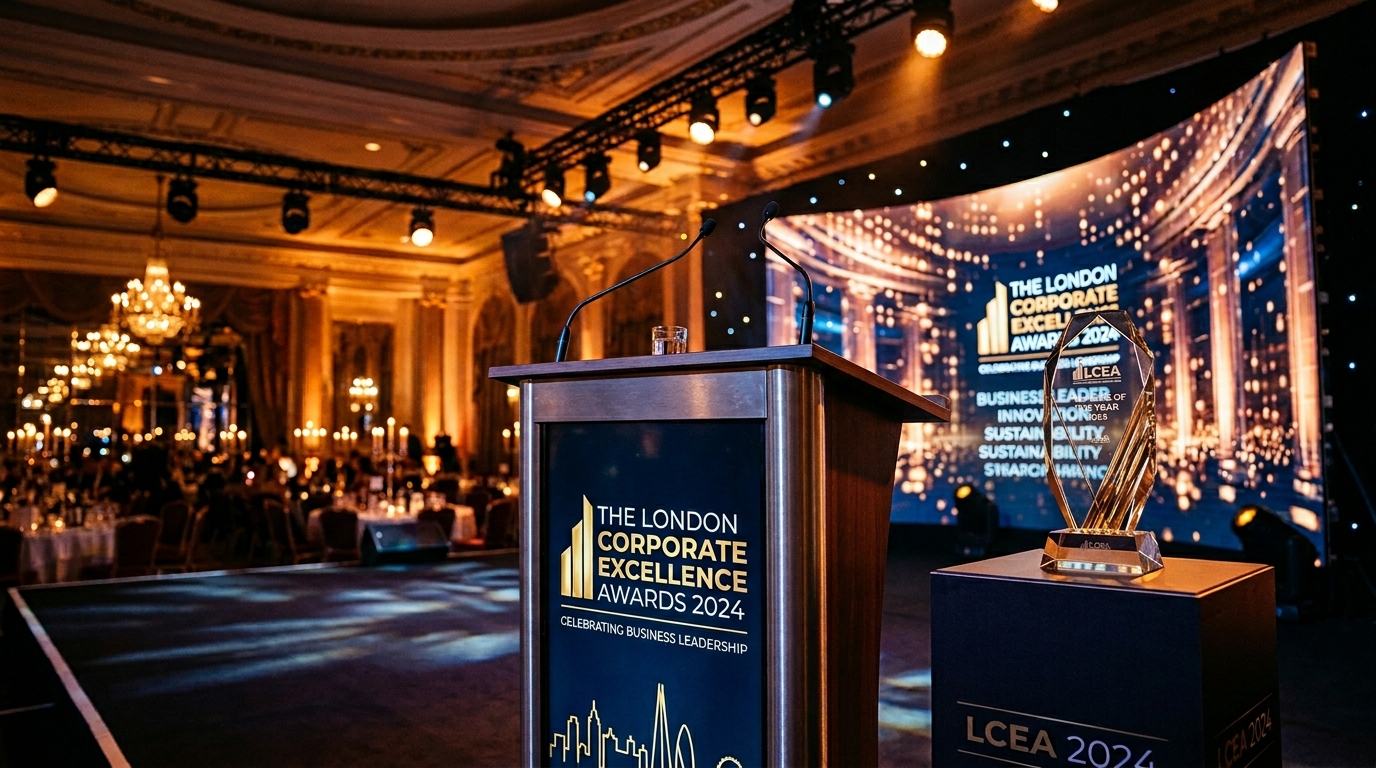
In practice, the brief I receive most often for an awards evening is a one-line email sent the morning of the event that says something like: covers the awards, needs good photos of the winners. That brief produces a library that covers the ceremony. It does not produce a library that serves the sponsor report, the press release, the LinkedIn campaign, the internal communications pack, and next year’s promotional materials. A thorough brief produces all of those.
As Retines Photography’s 2025 guide to event photography brief quality and output shows, the quality and commercial usefulness of an event photography library is directly correlated with the quality of the brief provided before the event. The specific information an awards photographer needs to produce a library that serves every intended purpose includes:
- The full running order with category names and approximate timings. Not just the start time of the ceremony. Every category, the name of the presenter for each where known, and any indication of which categories are highest priority for the client.
- A seating plan or at least a table plan. Even a rough indication of where key guests, winners, and sponsors are seated allows the photographer to plan their movement through the room to capture announcement reactions from the right positions.
- A named list of individuals who require specific portrait coverage. Not just winners. Also sponsors, executives, board members, celebrity guests, or any individual whose portrait is a deliverable for internal or external communications.
- Sponsor visibility requirements. If specific sponsors need their logo to appear in a certain number of images or in certain types of shots, state this explicitly. The photographer can then ensure those elements are included in the coverage plan rather than captured by chance.
- The intended channels and formats for the finished images. LinkedIn, press, internal newsletter, annual report, next year’s event marketing, sponsor report. Each channel has different format requirements, and knowing them in advance means images are composed and cropped accordingly.
After the Event: Turning Your Awards Library Into a Month of Content
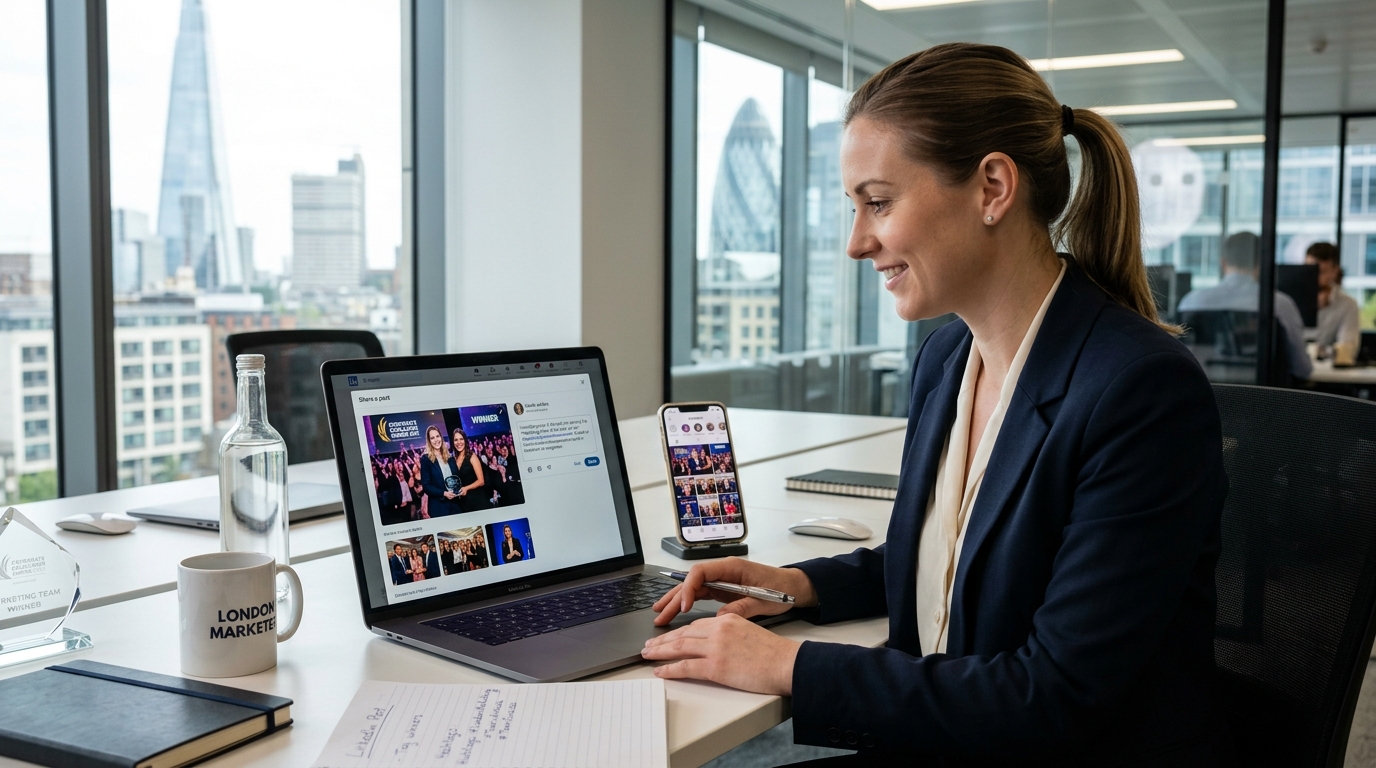
One of the most consistent patterns I see after awards evenings is a client who posts the group photo on LinkedIn the day after the event and then does not touch the library again for six months. That is a significant missed opportunity. A well-photographed awards evening produces enough distinct images to support four to six weeks of structured content across multiple channels.
As Neurapix’s guide to post-event photography content deployment strategy3, organizations that plan their post-event content deployment in advance consistently achieve significantly higher engagement and reach from their awards photography than those who deploy images reactively as needs arise. The awards event photo strategy that produces the strongest results across a four-week post-event window typically includes:
Week one: Immediate recognition content
The first week after the awards evening is the highest-engagement window for recognition content. Individual images of each winner with their trophy sent directly to the winner, their team, and their LinkedIn connection is the highest-performing awards photography content in terms of shares and reach. A personal message from the organiser accompanying the image, with permission for the winner to share it publicly, produces organic amplification that no paid promotion can match. For a twenty-category awards evening, this is twenty separate pieces of individually targeted content deployed in the first five working days after the event.
Week two: Event recap and editorial content
The second week is the right timing for the broader event recap: a LinkedIn article or post summarising the evening with five to eight strong images covering the room, the ceremony, and the atmosphere. This content reaches the audience who were not at the event and communicates the quality and scale of the evening to a wider audience than the immediate post-event posts. A short editorial piece by the organizer or a senior leader, illustrated with professional London Awards photography, performs consistently well on LinkedIn and provides evergreen content that can be shared by both the organiser and the venue.
Week three: Sponsor and stakeholder content
The third week is the time to deliver sponsor-specific image packs: a curated selection of images showing each sponsor’s branding in context, their representatives at the event, and the award categories they were associated with. This content serves the sponsor’s own communications teams and fulfils any visibility commitments made in the sponsorship agreement. Delivering it proactively rather than waiting for sponsors to request it communicates professionalism and builds the relationship for next year’s event.
Week four and beyond: Legacy and promotional content
The final week of the immediate post-event window is the time to capture the longer-term uses of the image library. Selecting the ten strongest images for next year’s event promotional materials, adding the best room setup images to the venue’s supplier portfolio, and identifying any images suitable for the annual report or employee recognition materials ensure the library continues working for the organization well beyond the immediate post-event period.
Frequently Asked Questions
How do I brief an awards photographer if winners are confidential until the ceremony?
Even when individual winners are confidential, there is still significant briefing information that improves the quality of the photography. Share the full shortlist for each category so the photographer knows which tables to watch during announcements. Share the ceremony running order so the photographer can plan their position for each category in advance. Share any information about the venue layout, the stage position, and the lighting setup. A photographer who knows the structure of the evening even without knowing the specific winners is significantly better prepared than one who arrives with no information. The winner information, where it can be shared, simply adds another layer of preparation on top of this foundation.
Should winners be told in advance that they will be photographed?
For corporate awards evenings, guests attending a formal event with photography have generally consented to being photographed as part of the event experience. However, for events where individual portraits will be used in external press or marketing communications, it is good practice to include a note in the event invitation or on the evening’s registration materials confirming that professional photography is taking place and that images may be used for organisational communications. For individuals who have specific concerns, an opt-out process managed by the event team rather than the photographer is the most appropriate approach. As Photier’s 2025 guide to event photography consent and communications4, clear advance communication about photography removes the ambiguity that occasionally arises when individuals see themselves in published images without prior awareness.
What is the best way to share award images with winners?
A private online gallery with individual download links for each winner is the most professional and most used approach. The photographer delivers the full library to the organiser, who then creates individual curated galleries for each winner containing their personal images. A personal message from the organiser or a senior leader accompanying the gallery link significantly increases the likelihood that the winner shares their images on their own channels, generating organic amplification for the event. Sending a compressed ZIP file via email is functional but lacks the professional presentation of a gallery link and is more likely to be downloaded, filed, and forgotten.
How far in advance should I book a London awards photographer?
For a London corporate awards evening, booking an experienced awards photographer at least six to eight weeks in advance is advisable. The most experienced corporate event photographers in London are in high demand for awards season months, particularly in the autumn and spring when the majority of industry awards programmes are concentrated. Booking late reduces your choice of photographer and increases the risk of finding that the specialist you want is already committed. The briefing process, including a venue visit if required, should begin at least two weeks before the event regardless of when the booking is made.
Is it worth commissioning video alongside photography at an awards evening?
For many London corporate awards evenings, a short highlight film alongside the photography library significantly extends the reach and impact of the event content. As Retines Photography’s guide to combined photo and video event production5, organizations that commission both photography and video from their awards evening consistently report higher social media reach and stronger sponsor satisfaction than those using photography alone. Joel Knight offers both photography and video production for corporate awards events through a trusted network of London videographers. See videography and filming services and AI video production at eventphotographer.com. photos for more detail on combined commissions.
Plan Your Awards Night Photography for Maximum Commercial Value
The difference between an awards photography library that serves your organisation for a week and one that serves it for a year is not the photographer. It is the strategy. The decisions you make before the evening, the communication you maintain on the night, and the content plan you execute in the weeks that follow determine whether your investment in awards night photography produces real commercial value or simply fills a shared drive.
Joel Knight is a London-based awards and corporate event photographer with extensive experience covering awards evenings, gala dinners, and recognition events for organisations across London and the UK. Browse the full corporate and awards photography portfolio and the conference photography portfolio at eventphotographer.photos, then get in touch via the contact page to discuss your awards evening.
REFERENCES & CITATIONS
- Bernardson Photography (2025). Pre-Event Strategy for Corporate Photography: Planning for Awards Evenings. bernardson.com. Cited in H2 Section 1. [Most commercially effective awards photography commissions begin with a structured pre-event planning process establishing clear objectives, comprehensive brief, and agreed deliverables before a single image is taken.]
- Retines Photography (2025). Event Photography Brief Quality and Output: How the Brief Determines the Library. retines.fr. Cited in H2 Section 3. [Quality and commercial usefulness of an event photography library is directly correlated with the quality of the brief provided before the event.]
- Neurapix (2025). Post-Event Photography Content Deployment: Strategy for Awards and Corporate Events. neurapix.com. Cited in H2 Section 4. [Organisations that plan their post-event content deployment in advance consistently achieve significantly higher engagement and reach from their awards photography than those deploying images reactively.]
- Photier (2025). Event Photography Consent and Communications: Best Practice for Corporate Awards Events. photier.com. Cited in H2 Section 5 FAQs. [Clear advance communication about photography removes ambiguity that occasionally arises when individuals see themselves in published images without prior awareness.]
- Retines Photography (2025). Combined Photo and Video Production for Events: Reach, Engagement, and Sponsor Value. retines.fr. Cited in H2 Section 5 FAQs. [Organisations commissioning both photography and video from their awards evening consistently report higher social media reach and stronger sponsor satisfaction than those using photography alone.]