
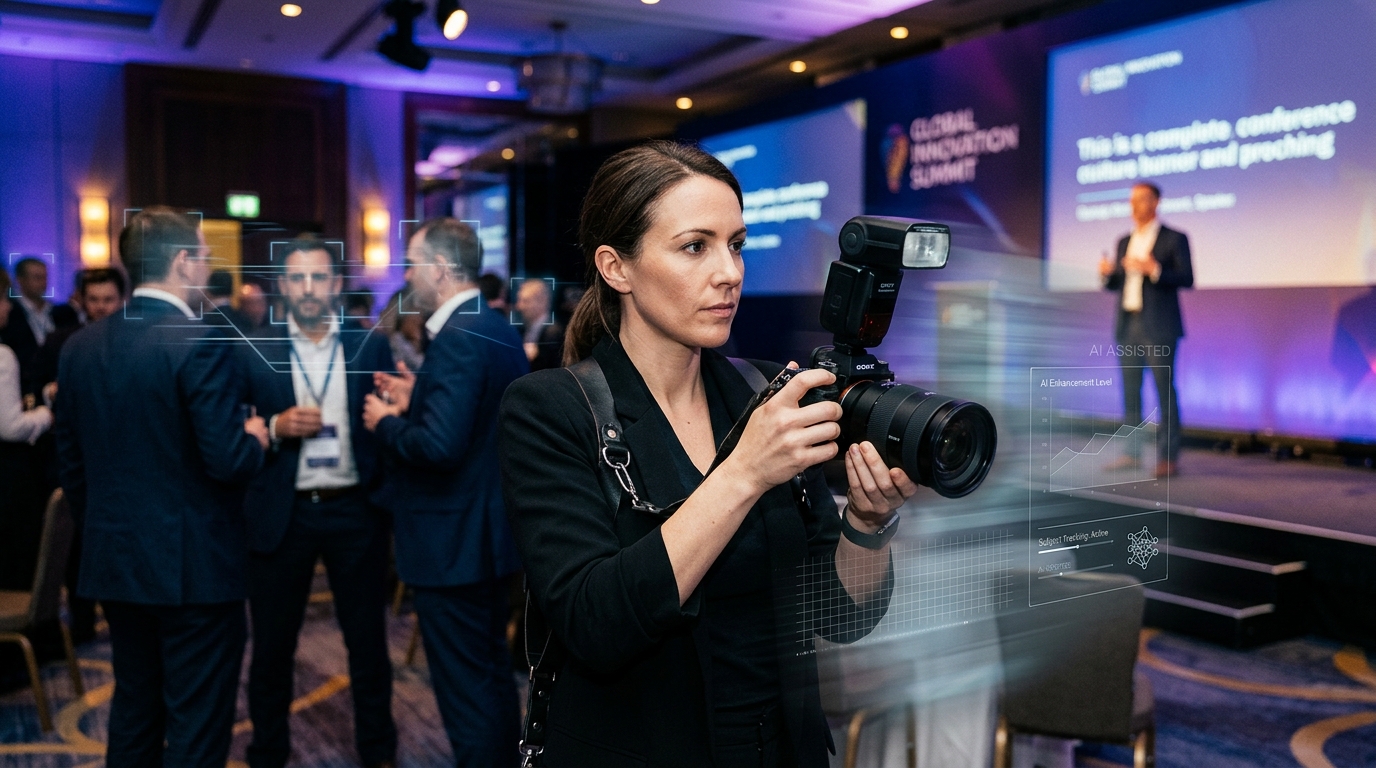
AI video for events is being offered by an increasing number of photography and videography companies in London, and most of the marketing around it is significantly clearer about what it promises than about what it actually involves. I have had conversations with clients who thought AI video meant fully computer-generated footage of their event, clients who thought it meant a chatbot would edit their event highlight reel, and clients who were not sure what they were being offered at all but felt they should want it.
The reality is more specific and more useful than the marketing typically suggests. AI video for events refers to a set of specific production and post-production workflows where artificial intelligence tools assist in the creation, editing, and delivery of video content from events. It is not magic and it is not a replacement for professional production. But used correctly, it enables video content from events to be produced and distributed faster, at lower cost, and with more consistency than traditional video production can achieve at equivalent price points. This guide explains exactly what it involves and when it makes commercial sense.
What AI Video for Events Actually Means in Practice
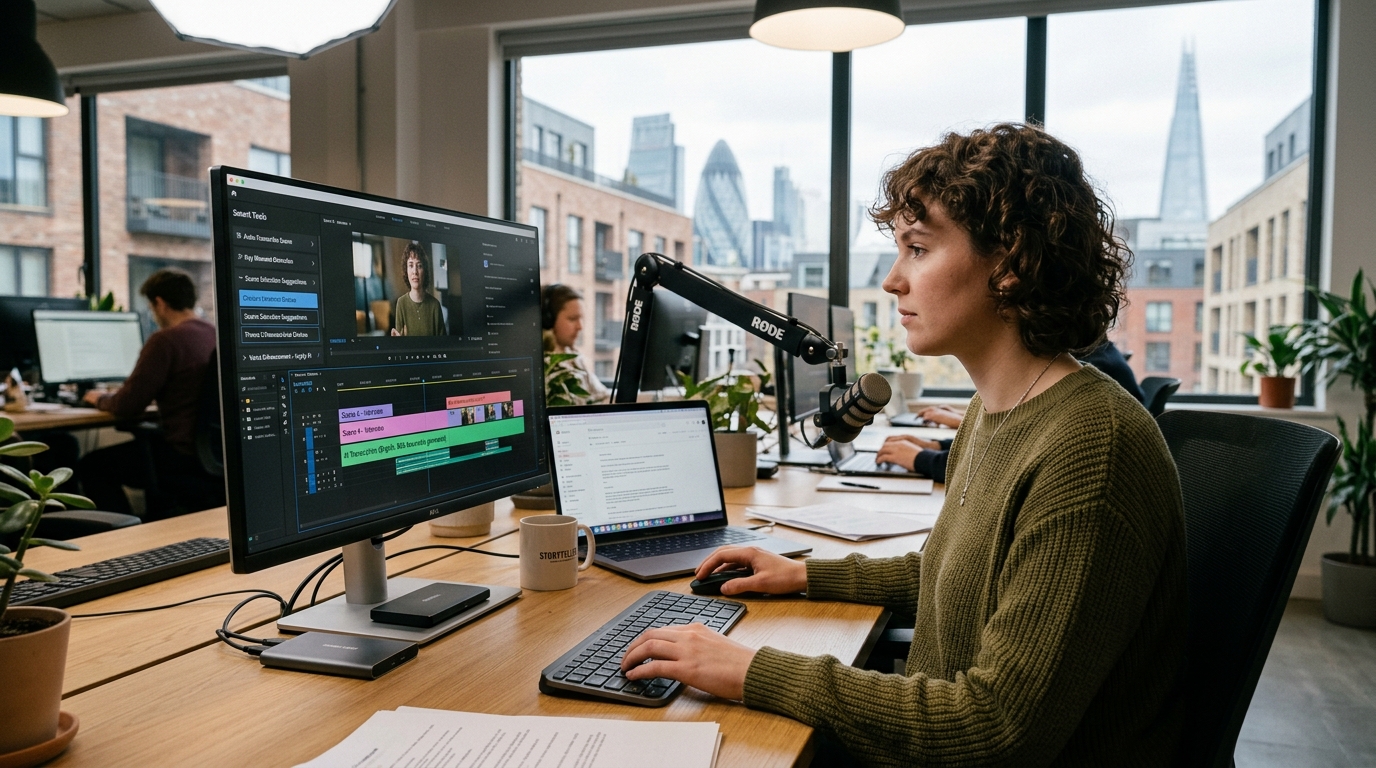
The term AI video covers a range of different production approaches, and not all of them are equally relevant to event coverage. In the context of corporate events, conferences, and awards evenings in London, AI video most commonly refers to three distinct workflows that are now commercially available and that produce genuinely useful event content at significantly reduced production time and cost compared to traditional video production.
Photier’s 2025 guide to AI video technology and its applications in event and corporate content production1, the AI video tools that are most commercially relevant to event coverage in 2025 are those that assist with three specific production tasks: intelligent editing and highlight selection from raw event footage, automated text and caption generation from event audio, and the creation of short-form social video content from event photography libraries. Each of these produces a distinct type of output and serves a different commercial purpose.
AI-assisted editing and highlight selection
The most commercially significant AI video application for event coverage is AI-assisted editing, where machine learning tools analyse raw event footage and identify the most engaging moments for inclusion in a highlight reel or summary video. Traditional video production requires a human editor to review every minute of footage before making selection decisions. AI tools can review the same footage in a fraction of the time, identifying moments based on speech patterns, audio energy levels, facial expression analysis, and motion characteristics. A human editor then reviews and refines the AI’s selections rather than starting from a blank timeline. For a one-day conference that generates eight to ten hours of raw footage, this can reduce the editing time for a highlight reel from two to three days to a matter of hours.
Automated transcription and caption generation
AI transcription tools can convert event audio, including keynote presentations, panel discussions, and speaker sessions, into accurate text transcripts and automatically generated captions within minutes of the footage being processed. This capability alone has significant commercial value for events: transcript content can be repurposed for blog posts, LinkedIn articles, and email newsletters without manual transcription cost, and automatically captioned video content performs significantly better on social media platforms where the majority of video content is watched without sound. The accuracy of AI transcription has improved to the point where the output requires light editing rather than full correction in most professional English-language event contexts.
AI video creation from photography libraries
The most novel AI video application for events is the generation of video content directly from a photography library rather than from video footage. AI tools can analyse a set of event photographs, create smooth motion effects that simulate camera movement across still images, generate transitions between shots, synchronise the resulting visual sequence to music, and deliver a finished video product without any traditional video filming having taken place. For events where a videographer was not commissioned, or where the event photography was strong but the videography was not, this approach produces engaging social video content from the photography asset that would otherwise remain static.
How AI Video Differs from Traditional Event Video Production
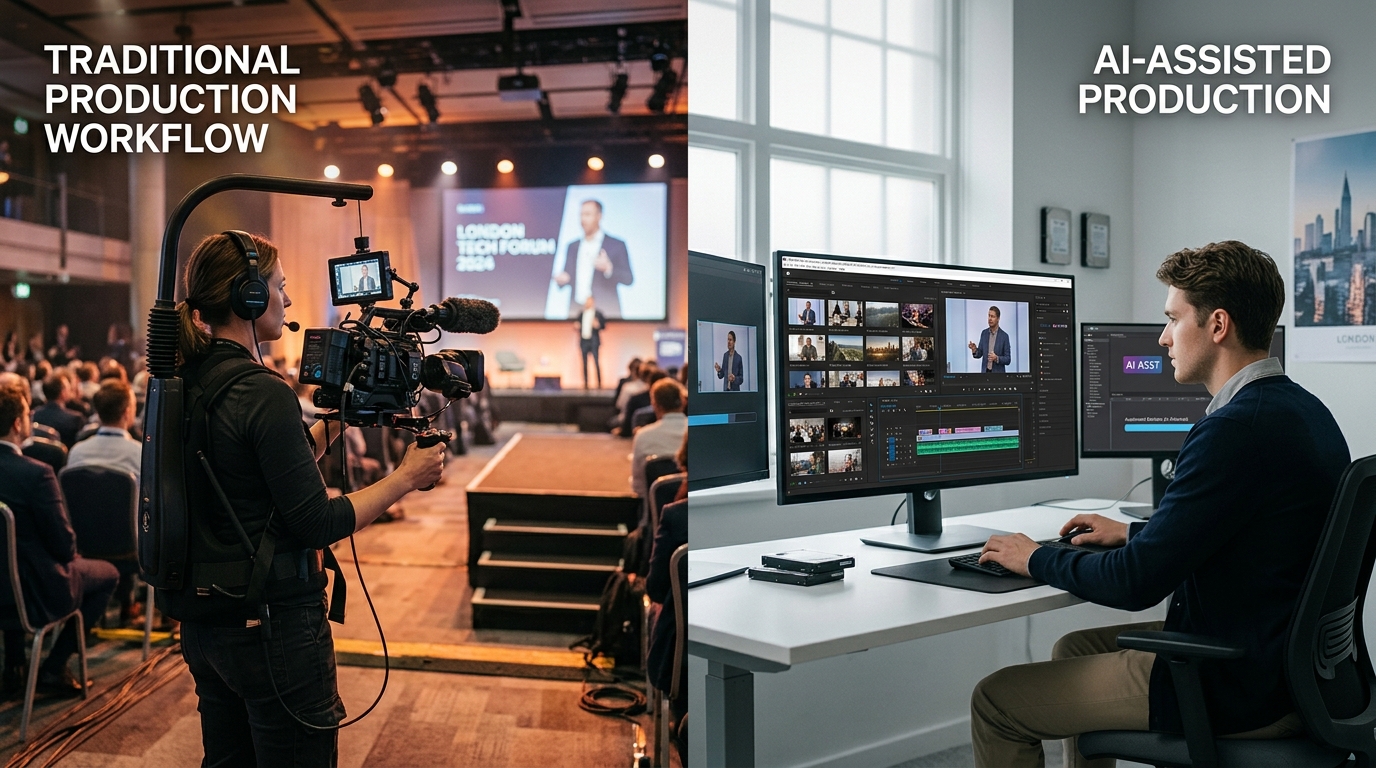
Understanding how AI video differs from traditional event video production is what allows an event organiser or marketing manager to make an informed decision about which approach is right for their specific event and their specific content requirements. The two approaches are not competing alternatives to the same output. They produce different types of content, serve different commercial purposes, and involve different production investments.
Bernardson Photography’s guide to AI-assisted content production and its relationship to traditional event photography and video2, the most significant practical differences between AI video production and traditional event video production are in production logistics, turnaround speed, and output format rather than in absolute quality. Traditional event video production requires specialist camera equipment, dedicated videography crew, and a post-production process that typically takes days to deliver a finished product. AI-assisted video production can work from footage captured by a single camera operator or even from photography alone, and can deliver finished social video content within hours of the event ending.
Production requirements
Traditional event video production requires a skilled videographer or video crew on site throughout the event, dedicated camera rigs, audio capture equipment separate from the event’s own sound system, and a comprehensive coverage plan that mirrors the kind of planning required for high-quality event photography. AI video for events can work from footage captured by a single camera operator using professional but less specialist equipment, from the event’s own recorded output, or from photography alone in the case of AI video generation from still images. This difference in production requirements has a direct effect on cost and logistics.
Turnaround speed
Traditional event video production typically delivers a finished highlight reel within three to seven days of the event, after the footage has been ingested, logged, reviewed, and edited by a human editor working through the full production pipeline. AI-assisted video production can deliver social-format highlight content within hours of the event, by processing footage through AI editing tools that identify and assemble the strongest moments without a full human review of every minute of footage. For events where same-day or next-day social video content is a commercial requirement, traditional production timelines are simply not compatible with the need. AI-assisted production is.
Output format and purpose
Traditional event video production is optimised for producing high-quality, comprehensive event films: polished highlight reels, full keynote recordings, conference documentation, and broadcast-quality content that serves the event’s archive and its most formal communications uses. AI video for events is optimised for producing social-format short-form content: sixty to ninety second highlight clips for LinkedIn and Instagram, captioned interview extracts, and motion-graphics-enhanced photography sequences that perform well on social platforms where the audience’s attention is measured in seconds rather than minutes. Both are commercially valuable. They serve different audiences and different distribution contexts.
The Specific Event Types Where AI Video Delivers the Strongest Return
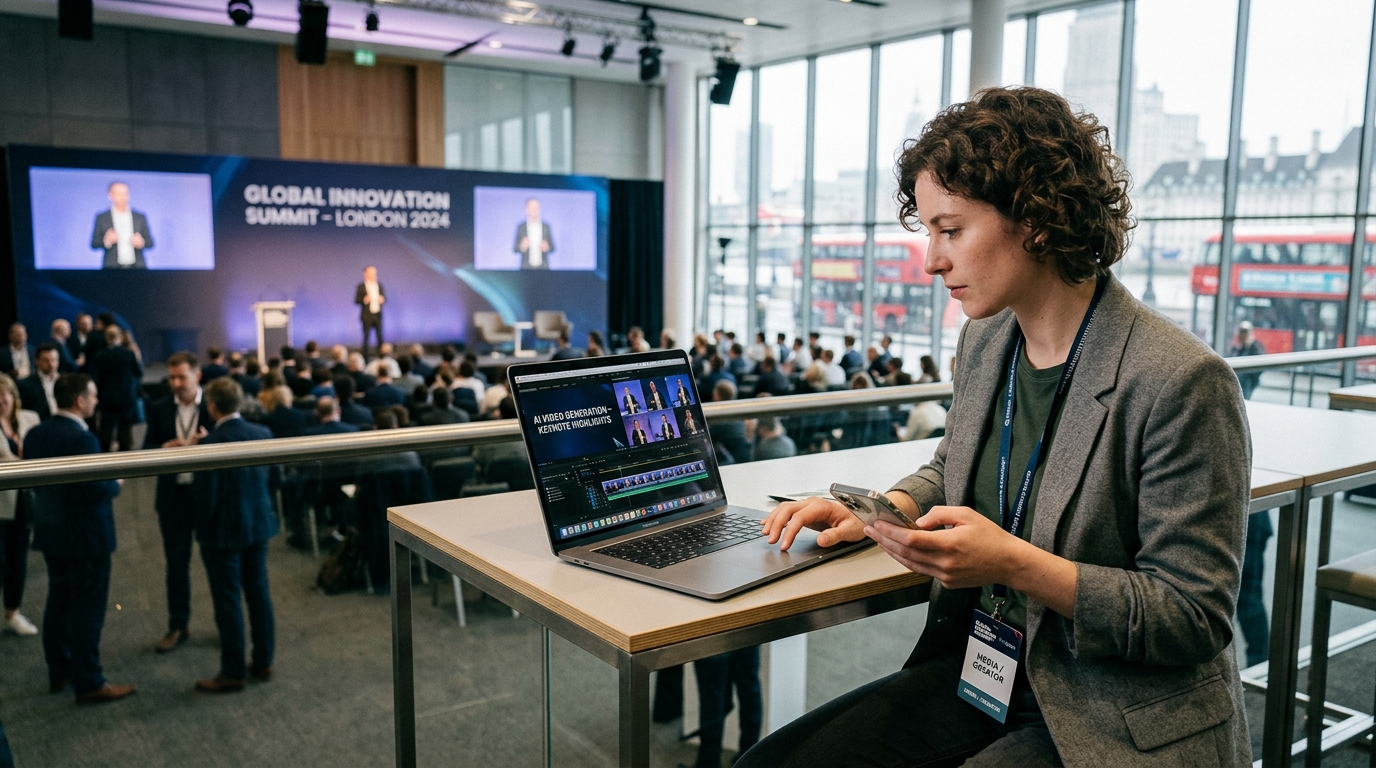
In practice, not every event type benefits equally from AI video. The events where AI video delivers the strongest commercial return are those where speed of content delivery is a high priority and where the primary distribution channel is social media rather than formal broadcast or archive use. For events where a polished, comprehensive video film is the primary output requirement, traditional production is still the stronger choice. For events where fast, high-volume social content is the goal, AI video is a genuinely significant commercial tool.
Retines Photography’s 2025 guide to event content production and the role of AI in social video delivery3, the event types that most consistently benefit from AI video production are those with a large social media audience, a strong internal communications requirement, and a specific need for video content within hours of the event rather than days. The specific event contexts where AI video is currently delivering measurable commercial value for London organisations include:
- Corporate conferences and all-staff events. A company-wide conference that brings employees together from multiple locations generates internal communications content that is most effective when shared while the energy of the event is still fresh. An AI-edited highlight reel delivered to the intranet on the afternoon of the event, featuring the keynote moments, the leadership addresses, and the atmosphere of the room, captures that energy in a way that a polished film delivered three days later cannot. The internal audience engagement window for this type of content is measured in hours, not days.
- Awards evenings and recognition events. The social media engagement window for corporate awards content peaks on the evening of the event and the following morning. AI video tools can produce a sixty-second highlight reel from the awards ceremony within two to three hours of the event finishing, capturing the trophy handovers, the winner reactions, and the atmosphere of the evening while the audience is still actively sharing and engaging with awards content. By the time a traditionally produced highlight reel is delivered three to five days later, that engagement window has closed.
- Product launches and brand activations. A product launch where the target audience is actively engaged in social media conversation about the event during and immediately after it is exactly the context where AI video speed provides a commercial advantage. A highlight clip posted within the hour while attendees are still sharing their own content about the launch reaches an audience that is primed and ready to engage. Traditional production cannot serve this window.
- Events without videography coverage. For events where a videographer was not commissioned and the photography library is the only visual asset produced on the day, AI video generation from photography can produce engaging motion video content that would otherwise be impossible without a reshoot. A thirty to sixty second montage of strong event photography, assembled with AI motion effects and synchronised to music, performs significantly better on social media than a static image gallery and can be produced within the same day as the photography delivery.
What to Ask Before Commissioning AI Video for an Event

The rapid growth of AI video as a service category has produced a significant range of quality and capability among providers. Some AI video services produce genuinely strong social content from event footage and photography. Others produce content that looks automated, feels generic, and does not represent the event or the organisation at the standard that a professional commission should. Knowing what to ask before commissioning is what separates a productive investment from a disappointing one.
Neurapix’s guide to evaluating AI video production services for corporate and event content4, the questions that most effectively distinguish high-quality AI video providers from generic automated services are those that probe for human creative involvement in the process rather than the technical capability of the AI tools themselves. The AI tools are increasingly similar across providers. The creative judgement applied to selecting which footage to process, how to structure the output, and how to ensure the result accurately represents the event is what varies most significantly. The specific questions to ask before commissioning include:
- What human creative input is involved in the editing process? A genuine AI-assisted production workflow involves a human professional making creative decisions at the brief, selection, and review stages, using AI tools to accelerate the production process. A fully automated workflow uses AI tools without human creative review and typically produces content that is technically correct but generically assembled. Ask specifically who reviews the AI output before delivery and what their role is in shaping the final content.
- What is the source material requirement? Some AI video services require specifically formatted source footage and do not produce good results from general event photography or audio-heavy event footage. Understand what the service needs from you in terms of footage format, photography files, and audio quality before committing to a production approach that may not work with the assets your event will produce.
- What is the delivery format and timeline? Confirm the specific video formats that will be delivered, the aspect ratios and resolutions for each social platform you intend to use, and the delivery timeline from event day to finished content. A service that cannot commit to a specific delivery timeline for social-format content is a service that does not understand the primary commercial value of AI video for events, which is speed.
• Can you see examples from comparable events? Request examples of AI video content produced from events similar in type and scale to yours. A corporate awards evening and a product launch require different approaches, different content hierarchies, and different tonal registers. An AI video provider who can show you strong examples from your specific event type is a provider who understands the creative requirements of your commission.
Frequently Asked Questions
Is AI video as good as traditionally produced event video?
For different purposes, yes and no. For formal, high-quality event films intended for broadcast, archive, or prestigious presentation contexts, traditional video production still produces superior results because it involves more comprehensive footage capture, more sophisticated audio production, and more nuanced human editorial judgement throughout the production process. For social-format highlight content where speed and platform optimisation are the primary requirements, AI-assisted production produces content that is not only comparable but often more appropriate for the distribution context because it is specifically optimised for the platforms and formats where it will be seen.
Can AI video replace a videographer at an event?
Not entirely, and the claim that it can is one of the most misleading in the current market for event video services. AI video tools require source material: either footage captured by a camera operator or a strong photography library. AI cannot create footage of an event that was not captured by a professional on the day. What AI can do is significantly reduce the time and cost required to turn that source material into finished social content. The correct framing is not AI video instead of a videographer but AI video as part of a production workflow that includes professional footage capture or high-quality photography as its raw material. As Social Tables’ guide to AI-assisted event content production and its realistic capabilities5, the events that achieve the strongest results from AI video are those that combine professional photography or videography on the day with AI-assisted post-production for fast social content delivery, not those that attempt to use AI tools to replace the on-site professional capture entirely.
How much does AI video for events cost?
The cost of AI video for events varies significantly depending on whether it includes on-site production, the volume and complexity of the source material being processed, the number of finished video formats required, and the level of human creative involvement in the production workflow. At the simpler end, AI video generation from an existing photography library to produce a single social highlight clip is a relatively modest addition to a photography commission. At the more complex end, a full AI-assisted event video production including footage capture, AI editing, multiple platform formats, and same-day delivery is a more significant investment that reflects the combined cost of the on-site production and the accelerated post-production workflow. Specific pricing should be discussed at commissioning stage with a clear brief about what the finished content needs to achieve.
How quickly can AI video be delivered after an event?
For social-format highlight content from a well-produced photography or video library, AI-assisted production can deliver finished content within two to four hours of the event ending, and in some workflows, same-day delivery during the event itself is achievable for priority clips. The speed is one of the primary commercial advantages of AI video over traditional production. It is not achieved without preparation: the source material needs to be organised and transferred efficiently, the brief needs to be clear about which moments to prioritise, and the review and approval process needs to be streamlined. Agreeing the delivery workflow before the event is what makes same-day or next-day AI video delivery achievable in practice.
Does AI video work for events where I only have photography and no footage?
Yes. AI video generation from photography is one of the most commercially interesting capabilities in the current generation of AI video tools. A library of strong event photographs can be processed into an engaging motion video, with smooth Ken Burns-style camera movements across still images, transitions between shots timed to music, and text or caption overlays added to contextualise the content. The result is not a substitute for professionally captured video footage but it is significantly more engaging on social platforms than a static image gallery and it can be produced entirely from the photography library without any additional footage being required. Browse the full AI video production portfolio at eventphotographer.photos to see examples of AI video produced from event photography and footage, then get in touch via the contact page to discuss your event’s video content requirements.
Explore AI Video Production for Your Next London Event
AI video for events is a genuinely useful commercial tool when it is understood correctly and applied to the right content requirements. It is not a replacement for professional event production and it is not magic. It is a set of intelligent production workflows that allow event content to be created and distributed significantly faster than traditional production timelines permit, at price points that make professional video content accessible for events where a traditional video production budget is not available.
Joel Knight offers AI video production for corporate events, conferences, awards evenings, and brand productions across London, combining professional photography and footage capture with AI-assisted editing and delivery to produce social-format event content on the timelines that modern digital marketing requires. Browse the full AI video production portfolio, the conference photography portfolio, and the unit stills and BTS portfolio at eventphotographer.photos, then get in touch via the contact page to discuss your event.
REFERENCES & CITATIONS
- Photier (2025). AI Video Technology and Its Applications in Event and Corporate Content Production: Three Commercially Relevant Workflows. photier.com. Cited in H2 Section 1. [The AI video tools most commercially relevant to event coverage are those that assist with intelligent editing and highlight selection, automated text and caption generation, and short-form social video creation from event photography libraries.]
- Bernardson Photography (2025). AI-Assisted Content Production and Its Relationship to Traditional Event Photography and Video. bernardson.com. Cited in H2 Section 2. [The most significant practical differences between AI video production and traditional event video production are in production logistics, turnaround speed, and output format rather than in absolute quality.]
- Retines Photography (2025). Event Content Production and the Role of AI in Social Video Delivery: Speed as Competitive Advantage. retines.fr. Cited in H2 Section 3. [Event types that most consistently benefit from AI video production are those with a large social media audience, a strong internal communications requirement, and a specific need for video content within hours of the event rather than days.]
- Neurapix (2025). Evaluating AI Video Production Services for Corporate and Event Content: Human Creative Involvement as the Key Differentiator. neurapix.com. Cited in H2 Section 4. [The questions that most effectively distinguish high-quality AI video providers from generic automated services probe for human creative involvement in the process rather than the technical capability of the AI tools themselves.]
5. Social Tables (2025). AI-Assisted Event Content Production and Its Realistic Capabilities: The Combination Model. socialtables.com. Cited in H2 Section 5 FAQs. [Events achieving the strongest results from AI video combine professional photography or videography on the day with AI-assisted post-production for fast social content delivery, not those attempting to use AI tools to replace on-site professional capture entirely.]