
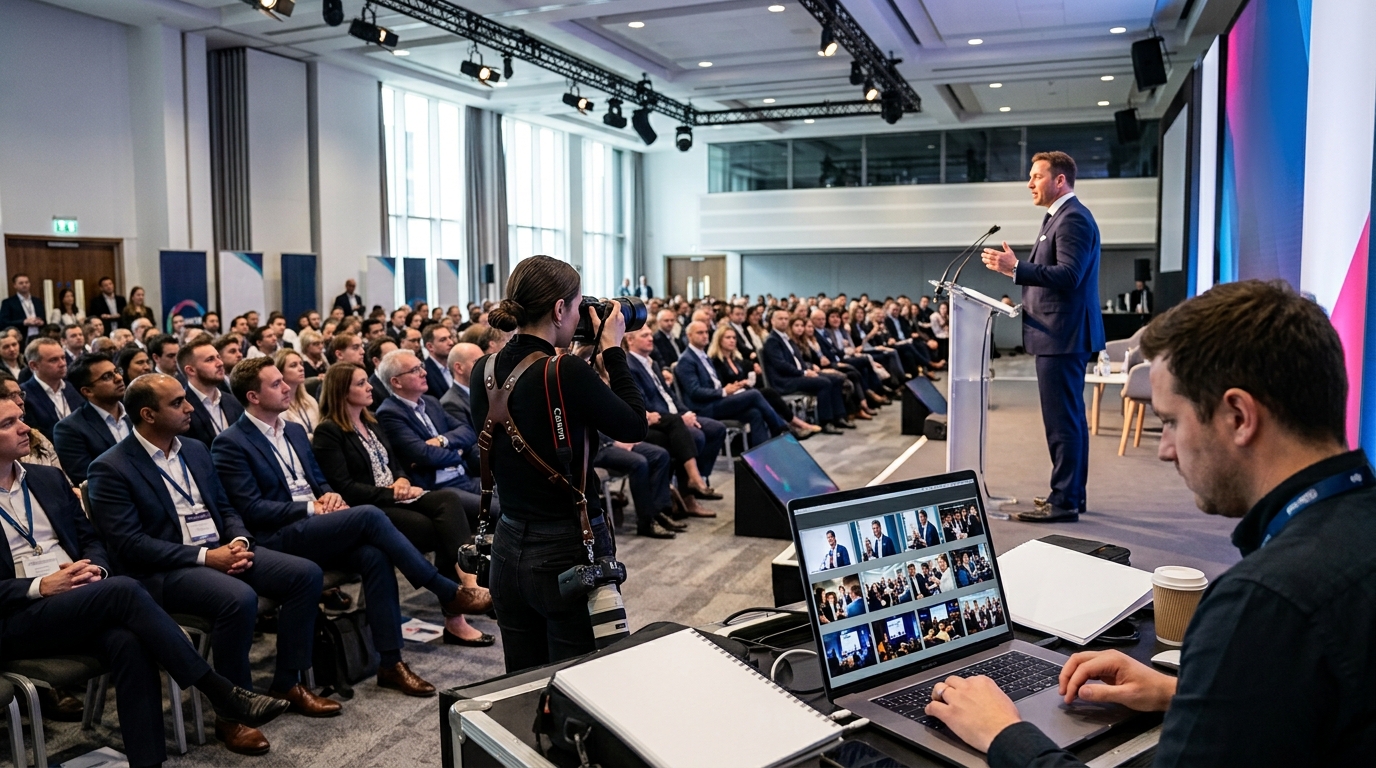
When you hire a corporate event photographer, the deliverable is not simply ‘photos’. The useful question is what photographs you will receive, how many will be edited, what format they will arrive in, how quickly they will be delivered, how the gallery will be organised, and what your business is actually allowed to do with the files afterwards.
Those details matter because two photographers can quote for the same four-hour event and be offering very different outcomes. One may include a carefully edited high-resolution gallery, fast delivery and broad commercial usage. Another may quote only for attendance and leave image quantity, turnaround, file format or licensing unclear until after the booking.
For marketing teams, communications managers and corporate event organisers in London, the best way to compare photographers is therefore to compare the complete corporate event photography deliverables rather than the hourly rate alone. This guide explains what a professional package should define before the event and what you should expect to receive afterwards.
What Should Corporate Event Photography Deliverables Include?
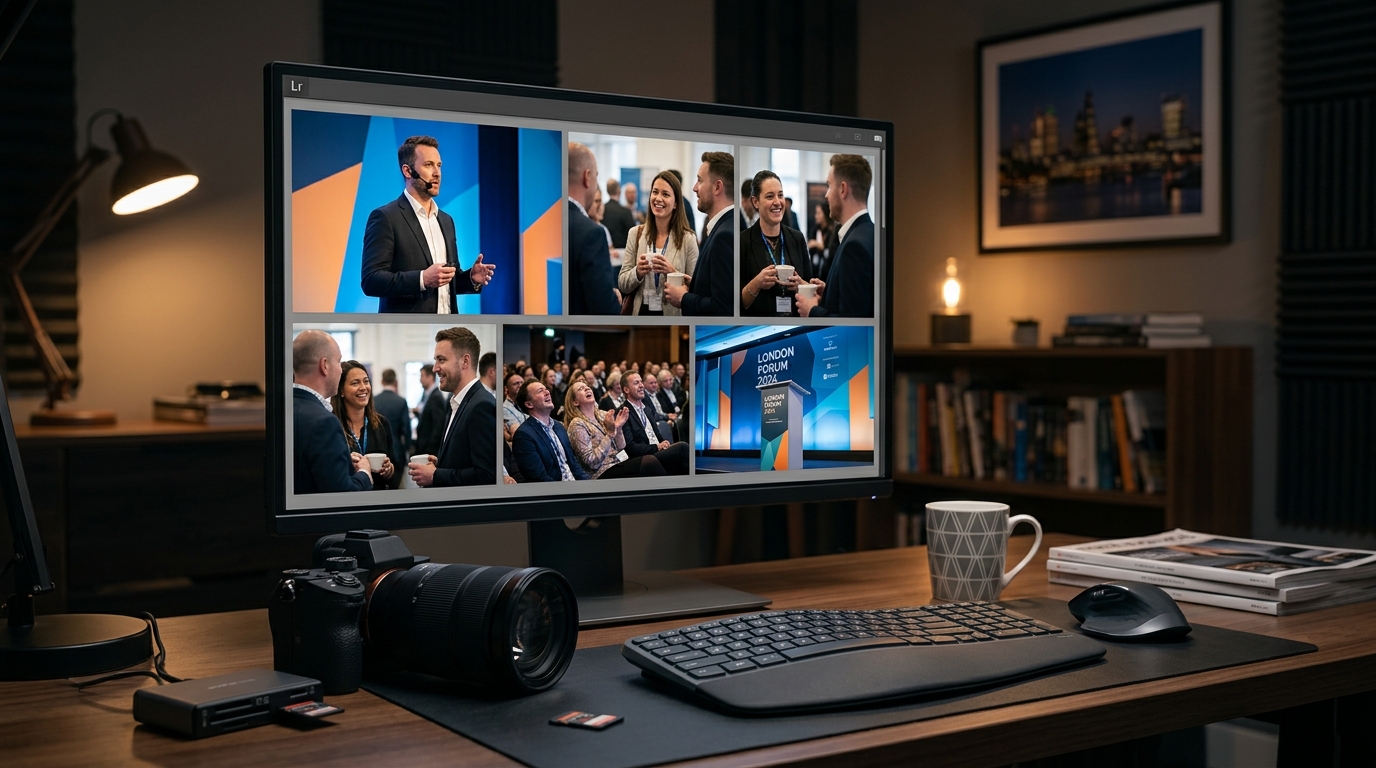
Frederic Paulussen’s corporate event photography guide1 recommends defining exactly what the client receives and when it will be delivered. That is the right starting point because a deliverable should be specific enough that both client and photographer understand the finished product before the event begins.
A strong corporate photography package should normally define six things: the amount of coverage, the edited image output, the delivery method, the turnaround time, the file format and resolution, and the usage rights attached to the photographs. If one of those is missing, ask about it before confirming the booking.
1. A curated set of professionally edited final images
The finished gallery should be a selection of usable photographs, not an indiscriminate dump of every frame captured. Professional event coverage involves culling duplicates, missed expressions, test frames and technically weaker images, then editing the strongest photographs so the final library feels consistent. Basic editing normally includes exposure, colour, white balance, contrast, cropping and tonal adjustments. More complex retouching, background reconstruction or extensive object removal is a different level of post-production and should be quoted separately when required.
2. A realistic image quantity or delivery range
Clients often ask for a guaranteed number of photographs, but event output is affected by the event format. A networking reception produces photographs at a different rate from a one-hour keynote where the audience remains seated. What matters is that the photographer gives you a realistic range and explains what affects it. On EventPhotographer.photos, the FAQ currently states that clients can expect around 60-80 fully edited images per hour depending on the size, type and flow of the event. That is a useful expectation for this particular service, not a universal industry rule.
3. A defined delivery deadline
Your agreement should distinguish between the full gallery and any urgent selects. A communications team may need 10-20 strong photographs the same day for LinkedIn, press or internal channels even when the complete gallery is delivered later. If speed matters, put that requirement in the brief rather than assuming fast delivery is included.
Joel Knight’s event photography pricing and rates page is useful here because it sets out what is included in the service, including professional editing, a private online gallery and current package examples.
Edited Images, File Formats and Resolution: What Should You Receive?
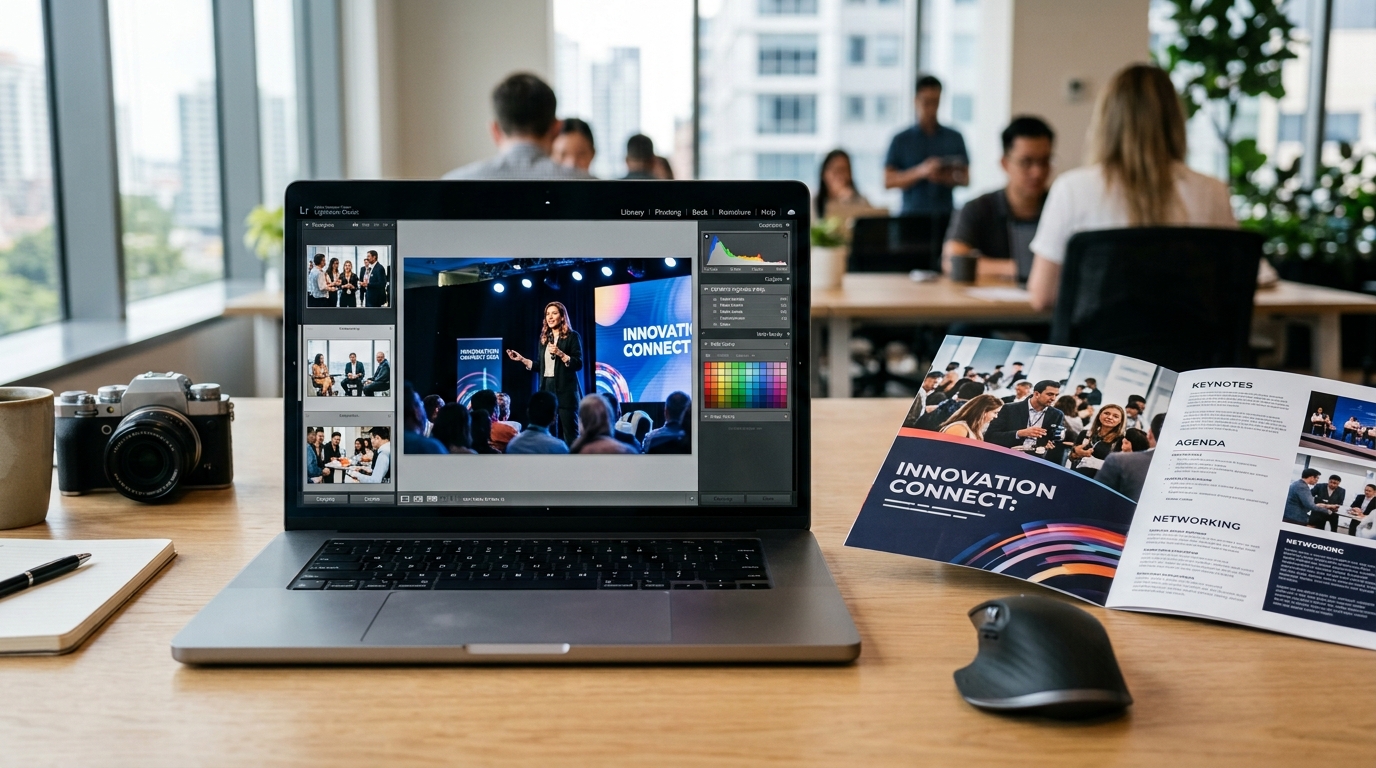
Adobe’s explanation of JPEG and RAW files2 notes that RAW files contain the unprocessed sensor information and are substantially larger, while JPEG files are processed and far more practical for normal viewing, downloading and sharing. For most corporate clients, edited JPEGs are therefore the useful final deliverable.
The words high resolution sound reassuring, but they are not enough on their own. Ask what file type is supplied and whether the files are suitable for the channels your organisation actually uses.
High-resolution edited JPEGs
High-resolution JPEGs are the standard practical deliverable for most corporate teams because they are easy to download, archive, place into presentations, send to publications and use for print when the original dimensions are sufficient. EventPhotographer.photos states that high-resolution edited JPG files are its normal delivery format.
Web-ready versions when your team needs speed
A communications team posting immediately to a CMS or social platform may also benefit from smaller web-ready files. They load and transfer faster and reduce the chance that a colleague uploads an unnecessarily huge master file to a website. If both versions are useful to your workflow, ask whether the photographer can supply or make them available through the gallery.
RAW files are not the same as finished photographs
RAW files are working files rather than finished deliverables. They normally require specialist software and further editing. Some commercial photographers never provide them; others make them available by agreement or for an additional fee. The important point is not whether RAW files are included, but whether the policy is clear before you book. On this website, RAW files can be supplied to commercial clients on request for an additional fee.
Retouching should be separated from standard editing
Colour correction and exposure adjustment are normal event-photography editing. Detailed skin retouching, compositing, removing complex objects, replacing backgrounds or heavily altering a scene are not the same service. If executive portraits, sponsor images or hero photographs need premium retouching, identify them separately so the scope and turnaround remain realistic.
The event photography FAQs clarify the current editing policy, expected image volume, standard high-resolution JPG delivery and RAW-file options, making that page an important internal link for clients comparing deliverables.
How Should a Corporate Event Photo Gallery Be Delivered and Organised?

Pixieset’s client gallery documentation3 shows why online galleries have become a practical delivery method: they can support both web-ready and high-resolution downloads while giving clients a clean place to review, share and retrieve the finished photographs.
Delivery method sounds like a small operational detail until a 250-image event gallery arrives as a temporary file-transfer link with no useful preview. For a corporate client, the delivery experience should make it easy for several stakeholders to find, review and use the photographs without asking the photographer to resend files repeatedly.
A private online gallery
A private gallery allows the client to scan the entire event visually before downloading. That is especially useful when marketing, PR, HR and leadership teams all need different images from the same event. EventPhotographer.photos includes image delivery through a private online gallery in its current pricing.
Logical sequencing and curation
The gallery should tell the story of the event rather than feel random. Registration and venue details normally appear before keynotes, networking, awards or evening coverage. For a multi-session event, separating or sequencing major parts of the day makes the library easier to search. The objective is not complicated folder architecture; it is reducing the time your team spends hunting for one speaker, one sponsor activation or one award presentation.
Sharing and stakeholder access
Ask whether the gallery can be shared internally and whether individual images can be downloaded without downloading the entire collection. For communications teams working with agencies, speakers, sponsors or media contacts, this can remove unnecessary file transfers and duplicated storage.
Archiving and retention
Do not assume a photographer will keep the gallery online forever. Confirm how long the photographs are archived and whether there is a charge for restoring an old gallery. EventPhotographer.photos states on its licence page that high-resolution JPEGs are supplied through a secure download link and that images are archived for a minimum of 12 months after delivery.
Usage Rights Are Part of the Deliverable, Not Fine Print
UK Intellectual Property Office guidance on commissioned photographs4 explains that when an organisation commissions an independent photographer, the photographer will usually remain the first copyright owner unless another arrangement is agreed. The client receives the usage rights granted by the licence, which is why licensing belongs in the deliverables conversation.
A beautifully edited gallery is not fully useful to a business if nobody knows whether the photographs can be used on the website, in PR, on social media, in recruitment campaigns, in paid advertising or by partner organisations. The usage licence should therefore be understood before the event, not after a campaign manager asks for clarification three months later.
Internal and PR use
For many corporate events, the core requirement is broad use across the company website, social channels, press releases, internal communications and presentations. If that is what you need, confirm that the licence covers it explicitly.
Advertising and third-party use
Paid advertising, resale, syndication, use by sponsors or transfer to partner organisations can be treated differently depending on the photographer and licence. Do not assume that because you can download a file you own every possible usage right to it.
Copyright ownership versus permission to use
These are different concepts. A company can have broad permission to use event photographs without owning the copyright itself. For most marketing teams, the commercial question is whether the licence is wide enough for the planned uses, not whether the company formally owns the underlying copyright.
For this service, review the unlimited commercial photography licence alongside the quotation so your team understands the permitted uses, copyright position, delivery and retention terms before the photographs enter your content library.
Frequently Asked Questions
How many edited photos should I expect from a corporate event?
There is no universal number because the output depends on event length, activity level, number of rooms and the brief. For this particular service, the current FAQ gives an expectation of around 60-80 fully edited images per hour, depending on the size, type and flow of the event. Use that as a service-specific range rather than a rule for every photographer.
Should all of the photos be edited?
The final delivered photographs should normally be professionally edited and curated. That does not mean every shutter press is delivered. Duplicate frames, test exposures, blinks, missed expressions and weaker images are normally removed during culling so the client receives the strongest usable library.
Should I ask for high-resolution and web-size files?
If your team uses the photographs across both print and digital channels, having access to high-resolution masters is important. Web-ready versions can also be convenient for CMS uploads and quick social use. Ask how the gallery handles download sizes so your team knows which file to use for each channel.
Are RAW files normally included in event photography?
Usually not as a standard finished deliverable because RAW files are unprocessed working files. Policies vary by photographer. EventPhotographer.photos states that high-resolution edited JPGs are the normal delivery and RAW files can be supplied to commercial clients on request for an additional fee.
How quickly should corporate event photos be delivered?
Turnaround should be agreed before booking because needs vary. Some clients are happy with a standard full-gallery deadline, while PR and social teams may require a small selection during or immediately after the event. Ask for the full-gallery deadline and the process for same-day or rush selects as two separate deliverables.
What should I confirm before signing the photography agreement?
Confirm attendance time, edited image expectations, delivery deadline, file format, resolution, gallery access, retouching scope, RAW-file policy, same-day requirements, archive period and usage rights. If those points are clear, the quotation becomes much easier to compare with other photographers.
Know What You Are Buying Before the Event Begins
The strongest corporate event photography agreement is one where the client knows what will arrive after the event before the photographer ever picks up the camera. Coverage hours matter, but the real value sits in the final edited library: the number and quality of usable images, the delivery speed, the formats, the gallery experience and the licence that allows your organisation to keep using those photographs.
When comparing quotes, do not ask only, ‘What is your hourly rate?’ Ask what the rate actually includes. A clearly defined package reduces misunderstandings and makes it easier for your marketing, PR and communications teams to plan around the finished assets.
Joel Knight provides corporate and event photography across London and the UK, with professional editing, private gallery delivery and clearly stated usage terms. If you already know your event date, venue and approximate coverage hours, the next step is to confirm the deliverables your organisation needs and build the quotation around them.
Contact Joel Knight to discuss your corporate event, delivery requirements and how the finished image library needs to work for your team.
REFERENCES & CITATIONS
- Frederic Paulussen. The Ultimate Guide to Corporate Event Photography. Recommends stating deliverables and turnaround explicitly so the client knows what the commission includes.
- Adobe. JPEG vs RAW. Explains that RAW files retain unprocessed sensor information and are substantially larger, while JPEGs are processed and more practical for normal sharing and use.
- Pixieset. Client Gallery – Share, Deliver, Proof & Sell Photos. Shows how professional client galleries can provide web-ready and high-resolution download options in an organised delivery experience.
- UK Intellectual Property Office. Copyright notice: digital images, photographs and the internet. Explains that the creator of a commissioned image will usually own copyright unless agreed otherwise and that usage depends on the licence granted.