

Sponsors do not invest in events simply to have a logo placed on a wall. They invest because they want access to an audience, meaningful brand visibility, useful conversations, content, and evidence that the activation actually happened. That creates an important role for event photography: not as a substitute for ROI data, but as visual proof of how a sponsor appeared, where the brand was seen, and how attendees interacted with the sponsored experience.
I have seen event galleries that document the speakers and audience beautifully but almost ignore the sponsors who helped fund the event. From the organiser’s perspective, the photography looks strong. From the sponsor’s perspective, there may be very little they can use in an internal recap, a LinkedIn post, a renewal discussion or a campaign report. That is a briefing problem rather than a photography problem.
If sponsorship matters commercially to your conference or corporate event, sponsor coverage should be planned before the doors open. This guide explains what event photography for sponsors should capture, how to build a sponsor-specific shot list, which images are useful in post-event reporting, and where photography fits alongside engagement and lead data when you need to demonstrate value honestly.
Why Sponsor Photography Is More Than Logo Coverage
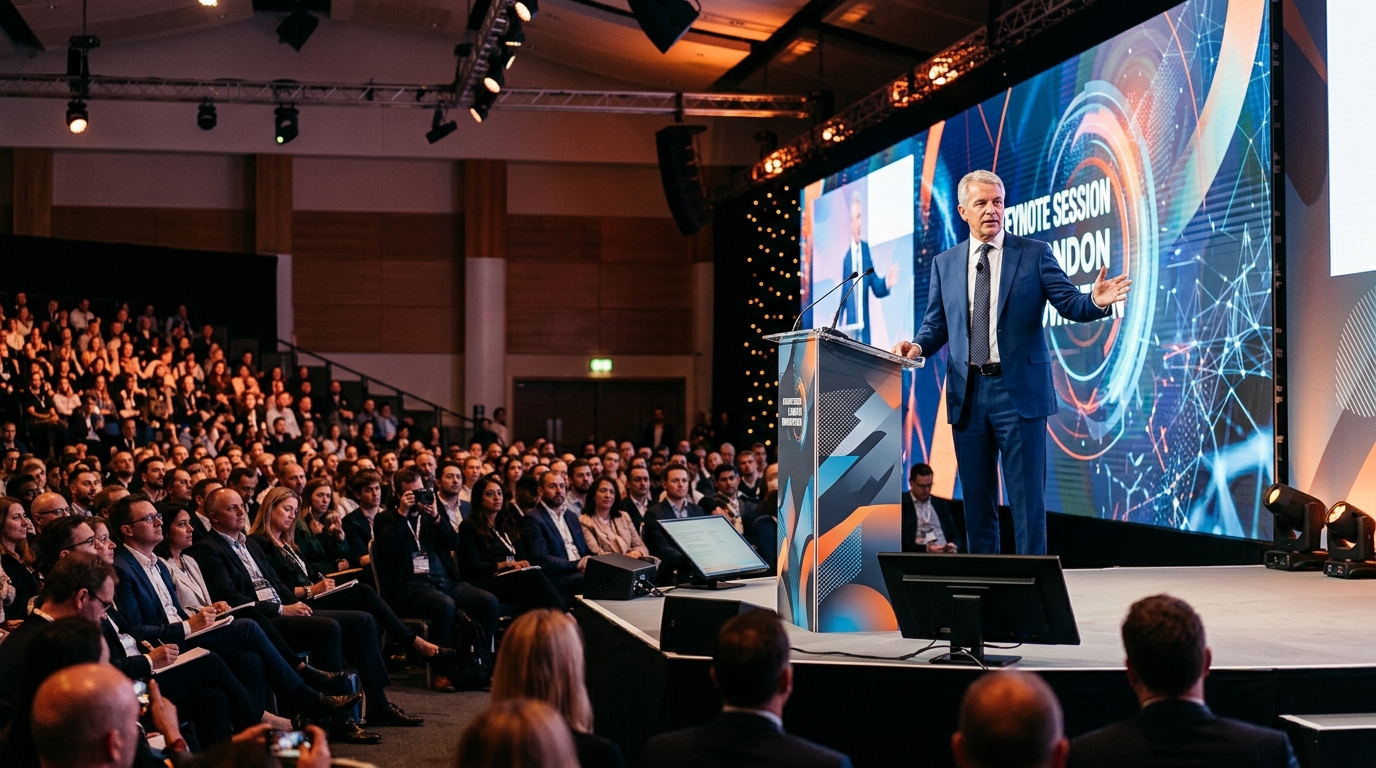
Bizzabo’s 2026 sponsorship ROI guidance1 argues that sponsors increasingly expect qualified engagement and measurable outcomes rather than passive logo exposure alone. That changes what useful sponsor photography needs to show.
Cvent’s 2026 event ROI analysis2 makes a related point: events are facing greater scrutiny from senior stakeholders, and teams need to connect the event to business outcomes rather than relying on attendance or surface-level activity as proof of value.
Photography cannot tell a sponsor how many qualified leads entered the pipeline. It can, however, document whether the promised physical and experiential elements were delivered. A clean photograph of a branded stage shows that the sponsor had stage presence. A wider frame showing a busy activation in use shows that attendees encountered it. A sequence of product demonstrations shows that the activation was functioning, not merely installed. A photograph of a sponsor representative in conversation with delegates documents real interaction without pretending to quantify its commercial value.
That distinction is important. Sponsor photography is strongest when it proves visible facts and supports the wider data story. It becomes weak when a report tries to make a photograph prove something the image cannot establish, such as lead quality, sales influence or revenue.
For event organisers, the goal should be to produce a library that serves both the event story and the sponsor story. The general gallery may prioritise keynote moments, audience energy and networking. The sponsor subset should deliberately document brand presence, activation, participation and context. Both can be captured during the same commission when the requirements are included in the brief.
For conferences with several sponsors or exhibitors, the Conference Photography London service is the natural internal destination because it already covers branding, exhibitor stands, networking, keynote sessions and multi-room event environments.
What Event Photography for Sponsors Should Capture

Cvent’s current sponsor-management guidance3 recommends defining sponsor KPIs before the event and including supporting documentation such as photographs, screenshots and links in the post-event report. That means the photography brief should be built around what was actually promised.
Events.com’s post-event reporting guide4 likewise recommends visual highlights of key sessions, crowds and sponsor displays because photographs make the report easier for external stakeholders to understand.
A sponsor shot list should not be a request for fifty photographs of logos. A useful library contains several different types of evidence, each answering a different question.
1. Fulfilment and brand presence
Start with clean evidence that promised assets were present. This can include stage branding, entrance signage, banners, exhibition stands, sponsored lounges, branded registration points, product displays, digital screens, printed materials and room naming. Photograph important assets both tightly enough to see the branding and widely enough to understand where the placement sits within the event.
2. Attendee interaction
A sponsor stand with no people can prove installation, but it does not communicate participation. Capture attendees using the activation, asking questions, testing products, speaking with representatives, entering a sponsored area or engaging with a demonstration. Natural interaction is more valuable than asking people to stand beside a logo simply to make the brand visible.
3. Sponsored content and thought leadership
If the package includes a sponsored session, panel, workshop, keynote introduction or branded content area, photograph the session as both an event moment and a sponsor deliverable. Include the speaker, audience, room context and relevant branding where possible. These images are useful for the sponsor’s own content as well as for the organiser’s fulfilment report.
4. Hospitality and relationship-building
Hosted dinners, VIP areas, networking lounges and drinks receptions are often designed around relationship-building rather than mass visibility. Here the strongest images may be small-group conversations, introductions and the atmosphere of the sponsored space rather than repeated logo shots.
5. Design and production details
Some sponsorship value is delivered through the physical design of the event. Before delegates arrive, photograph clean wide views and details of sponsored installations while the space is still pristine. These images are particularly useful when an agency, production company or venue needs to show how the branded environment was executed.
For this part of the brief, link the article to Event Production Design & Details, which specifically covers décor, stage design, branded setups and pre-opening venue photography.
How to Build a Sponsor Photography Shot List Before the Event
HeySummit’s sponsor deliverables and reporting framework5 treats sponsor reporting as something that begins before the event: organisers should know what was promised, who owns each deliverable and what evidence will be captured.
PCMA’s sponsorship survey6 found that sponsors increasingly ask for more detail about value and ROI, with attendee engagement and leads often carrying more weight than traditional brand-awareness assets alone.
The practical solution is a sponsor coverage matrix. It can be a spreadsheet, a section of the photography brief or a page in the production run sheet. The format matters less than the fact that each sponsor has defined visual requirements.
For every priority sponsor, give the photographer the sponsor name, sponsorship level, location, activation type, important branding elements, scheduled moments, named representatives and any images the organiser has contractually promised. If ten sponsors each need three specific deliverables, that should be visible before the photographer starts moving through the venue.
Which sponsor assets must be photographed before doors open?
Which activations need photographs with attendees actively participating?
Are there sponsored keynotes, panels, awards or announcements at fixed times?
Which VIPs, executives or sponsor representatives are priorities?
Does each sponsor need a minimum number of usable images?
Are any sponsor logos or competing brands subject to exclusivity rules?
Does the sponsor need landscape, portrait or social-first crops?
How quickly do selected sponsor photographs need to be delivered?
The photographer should also know what not to do. If a sponsor has paid for category exclusivity, an otherwise strong image may be unusable if a competing brand dominates the background. If a sponsor needs photographs for a formal report, a dramatic shallow-depth-of-field image where the activation is unrecognisable may be less useful than a cleaner contextual frame. Commercial usefulness should shape the shot, not just aesthetics.
File organisation matters as well. For complex events, sponsor images can be delivered in clearly labelled folders or tagged selections so the organiser does not have to search through hundreds of general event photographs to build ten separate reports.
How to Pair Sponsor Photos With Data to Prove ROI

Cvent’s event-success measurement framework7 recommends looking at measures such as booth engagement, lead generation, business opportunities and social activity when evaluating sponsorship and event performance.
Stova’s event analytics guidance8 shows how attendee journeys, sessions, exhibitors and sponsor interactions can be analysed across multiple event data points to create a fuller picture of event impact.
This is where event photography and event data should meet. The photograph explains what happened visually. The data explains scale, frequency or business outcome. Used together, they create a much more credible sponsor report than either one used alone.
For example, a photograph can show a well-attended product demonstration. Badge scans or lead-capture data can show how many attendees registered interest. A photograph can show a sponsored session with a full room. Attendance data can quantify the audience. A photograph can show brand presence across a networking lounge. Social analytics can show the reach of posts that used those images afterwards.
The wording in the report should stay disciplined. “Delegates participating in the sponsored demonstration” is a visual statement the image supports. “The demonstration generated qualified opportunities” requires lead or CRM evidence. Photography gains credibility when it is used for what it can prove rather than stretched into a metric it cannot prove.
A strong sponsor report can therefore pair each major deliverable with three layers: the agreed promise, a photograph or screenshot proving delivery, and the relevant performance data where that data exists. This structure makes the report faster to understand and gives the sponsor material they can reuse internally.
How Sponsor Photography Supports Renewals and Future Event Marketing

LinkedIn Marketing Solutions’ event guidance9 describes events as a before, during and after cycle, with continued content and analytics helping brands extend engagement beyond the live moment.
Freeman’s sponsorship strategy guidance10 focuses on creating sponsorships that work for both attendees and brand partners while supporting measurable ROI and longer-term relationships.
The commercial life of sponsor photography does not end when the fulfilment report is sent. A sponsor can use strong images in LinkedIn posts, internal recaps, case studies, sales presentations, annual reviews and next-year activation planning. The organiser can use the same library to demonstrate what sponsorship at the event actually looks like to prospective partners.
This is particularly valuable when selling the next edition of a recurring conference. A sponsorship deck filled only with floor plans and logo-placement diagrams asks the buyer to imagine the experience. A deck supported by strong photographs of previous activations, real attendee interaction, full sponsored sessions and well-executed branded spaces gives the prospective sponsor evidence of the environment they are buying into.
The same principle applies to renewal. When the organiser can return to a sponsor with a concise selection of professionally photographed deliverables, supported by the relevant engagement data, the conversation starts from documented performance rather than memory. That does not guarantee renewal, but it makes the value delivered easier to communicate.
For the broader content strategy after the event, see How to Use Conference Photos After the Event, which explains how a professional event library can be repurposed across PR, LinkedIn, websites, internal communications and future event marketing.
Frequently Asked Questions
What should sponsor event photography include?
At minimum, capture clean evidence of the sponsored asset, wider context showing where it appeared, attendee interaction where relevant, sponsored sessions or announcements, priority representatives and any contractual deliverables. The exact list should be agreed before the event rather than improvised afterwards.
Is photographing the sponsor logo enough?
Usually not. A logo-only image can prove that branding existed, but it says little about how the activation functioned or whether attendees encountered it. The strongest sponsor library combines branding with context and genuine participation.
How many photographs should each sponsor receive?
There is no universal number because sponsorship packages vary. Instead of promising an arbitrary quantity, define the required image families: presence, interaction, content, people and context. If a contract promises a minimum number of images, include that in the photography brief.
Can photographs prove event sponsorship ROI?
Photographs can prove visible delivery and participation, but they cannot independently prove lead quality, pipeline or revenue. Use them alongside attendance, scan, meeting, social, survey or CRM data where those outcomes need to be demonstrated.
Should sponsors have a separate photography shot list?
For events with important sponsors, yes. A sponsor-specific section inside the main shot list is usually enough. For a large conference with many partners, a sponsor matrix is more efficient because it identifies the required assets, locations, times and named people for each sponsor.
How quickly should sponsor photographs be delivered?
If sponsors need images for live social media or immediate PR, selected photographs should be identified for same-day or rapid delivery before the event. For fulfilment reports and renewal decks, the full edited gallery can follow on the standard delivery schedule agreed with the photographer.
Should every sponsor receive the same amount of photography coverage?
Not necessarily. Coverage should reflect the sponsorship package, commercial priority and agreed deliverables. A headline partner may need stage branding, VIP interaction, activation coverage and hospitality images, while a smaller sponsor may only require clear evidence of its stand or branded area. The photography brief should identify these differences before the event so coverage is intentional rather than evenly distributed by accident.
Can sponsors use event photographs on their own websites and social media?
Usually this depends on the photography licence agreed for the event. Organisers should confirm whether sponsors may reuse supplied images for websites, social media, PR, internal communications or paid campaigns before distributing them. Clear usage terms prevent confusion later, especially when several brands, agencies or commercial partners want access to the same image library.
How should sponsor photographs be organised after the event?
For events with several partners, separate sponsor folders or clearly labelled selections make the gallery much easier to use. Each sponsor’s set can include clean branding images, attendee interaction, sponsored sessions, key representatives and wider contextual photographs. Good organisation saves the event team from searching through hundreds of general images when preparing fulfilment reports or renewal presentations.
When should the sponsor photography shot list be shared with the photographer?
Share it as early as possible and ideally before the final event week. The photographer does not need every detail months in advance, but they should know which sponsors are priorities, where activations are located, which sessions are sponsored, whether specific representatives must be photographed and whether any images need rapid delivery. A final updated version can then be supplied with the event run sheet shortly before the day.
Plan Sponsor Photography Before the Event, Not After It
If sponsors are commercially important to your event, their photography should be part of the pre-event brief. The organiser should know which partners matter most, what each partner has been promised and what visual evidence will be useful after the event. The photographer can then capture those requirements while still producing natural, story-driven coverage of the conference as a whole.
The objective is not to turn the event gallery into a catalogue of logos. It is to create a balanced image library that shows brand presence, real participation, strong event design and the human interactions that make sponsorship meaningful. Paired with reliable event data, those images become useful assets for reporting, marketing and renewal conversations.
Joel Knight provides professional conference and corporate event photography across London and the UK, including keynote coverage, networking, exhibitions, branded environments, event production details and sponsor activations. Sponsor requirements can be incorporated into the photography brief before the event so priority deliverables are captured deliberately rather than left to chance.
Planning a sponsored conference or corporate event? Contact Joel Knight to discuss the schedule, sponsor priorities and the photography your post-event reporting will need.
REFERENCES & CITATIONS
- Bizzabo. Event Sponsorship ROI: How To Increase and Prove It. Explains the shift from passive logo exposure toward qualified engagement, measurable outcomes and specific post-event reporting.
- Cvent. How to Prove Event Value (& Why ROI Matters More Than Ever). Explains why event teams are under greater pressure to connect events to business outcomes rather than surface-level attendance metrics.
- Cvent. How to Get Sponsors for an Event in 2026. Recommends agreeing sponsor KPIs before the event and including supporting documentation such as photographs, screenshots and links in post-event reporting.
- Events.com. How to Write a Post-Event Report: Template + Metrics to Include. Recommends including photographs of sessions, crowds and sponsor displays as visual evidence in post-event reports.
- HeySummit. Sponsor Deliverables Checklist and Post-Event Sponsor Report Template. Defines sponsor reporting as a process that begins before the event by identifying promised deliverables and the evidence that will prove delivery.
- PCMA. Convene Survey: What Drives Event Sponsorships?. Reports that sponsors increasingly ask for engagement and ROI evidence rather than relying only on traditional visibility assets.
- Cvent. How to Measure Event Success: A Comprehensive Guide to ROI. Lists attendee engagement, booth traffic, lead generation, business opportunities and social metrics among useful measures for sponsorship and event success.
- Stova. Event Intelligence Platform: Analytics & Reporting. Shows how attendee journeys, session engagement, exhibitor activity and other event data can be combined to understand event impact and ROI.
- LinkedIn Marketing Solutions. LinkedIn Events. Highlights the value of continuing event engagement before, during and after an event, with content and analytics extending the life of the event.
- Freeman. Sponsorship Strategies for Today’s Live Experiences. Emphasises sponsor strategies that balance attendee value, brand objectives, long-term partnerships and measurable ROI.