
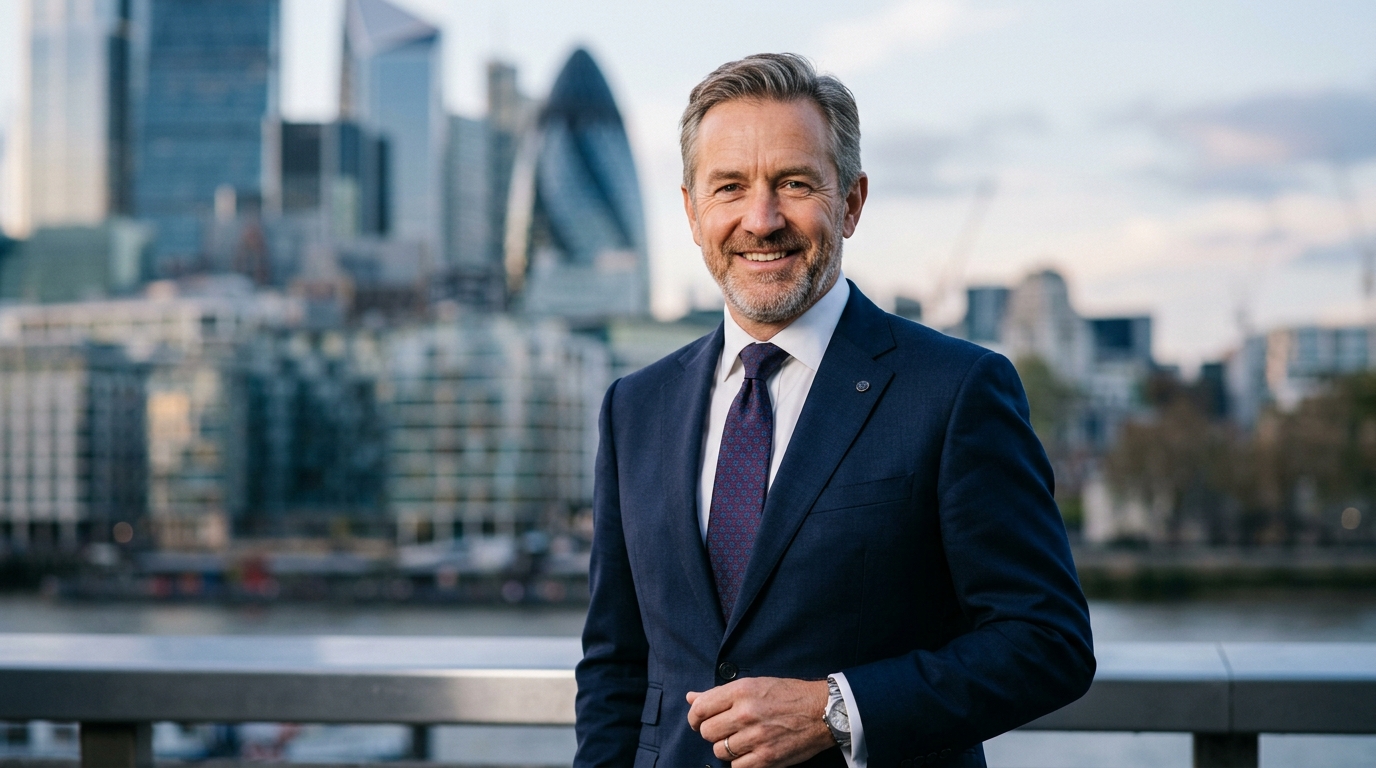
The most common objection I hear when a business owner or senior professional is deciding whether to invest in professional headshots is that they do not enjoy being photographed. My answer is always the same: nobody is looking at your headshot to see whether you enjoyed having it taken. They are looking at it to decide whether you are the kind of professional they want to work with, speak to, or trust with something important. That decision is made in a fraction of a second, and it is made entirely from the image.
A professional headshot is not a vanity purchase. It is the first impression your business makes in every digital context where a handshake is not available: your LinkedIn profile, your company website, your speaker biography, your press kit, your client proposal, and the inbox of every journalist, editor, or decision-maker who receives your details before they have met you. This guide covers exactly what a professional headshot does commercially, why phone photographs and outdated images cost more than they save, and what London professionals and businesses need to know before they commission one.
The First Impression Problem That Professional Headshots Solve
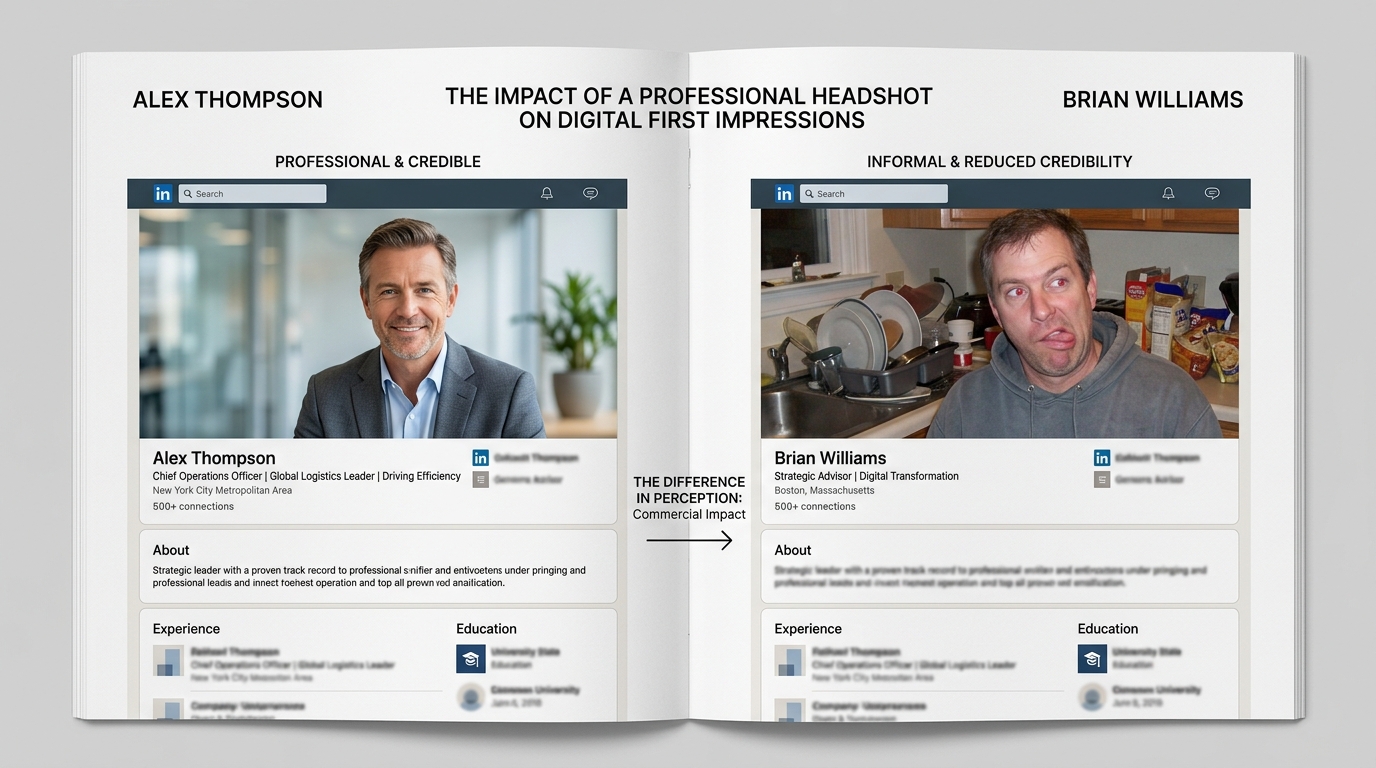
Every digital platform where professionals are visible to potential clients, employers, collaborators, or media contacts operates as a first impression machine. LinkedIn, company websites, Google search results, conference speaker profiles, and press coverage all display a photograph of the individual alongside whatever information is being communicated about them. That photograph is not decoration. It is the primary signal through which the viewer forms an initial impression before reading a single word.
LinkedIn Business’s research on professional image and audience engagement1 confirms that LinkedIn profiles with professional headshots receive significantly more profile views, more connection requests, and more messages than equivalent profiles with informal photographs or no photograph at all. The research identifies the headshot as the single highest-impact element of a LinkedIn profile for generating engagement, outperforming the headline, the summary, and the experience section in terms of the attention it generates from people who have not yet connected with the individual.
The specific commercial problems that professional headshots solve include:
- The credibility gap. A professional whose online presence is illustrated by a phone photograph taken at a social event, a cropped group photo, or an image more than three years out of date is creating a credibility gap between the quality of their work and the quality of their professional presentation. In a competitive London market where multiple qualified professionals are being evaluated simultaneously, that credibility gap consistently disadvantages the professional whose image communicates less investment and less care.
- The recognition gap. When a client, journalist, or conference organiser who has only seen a professional in a digital context meets them for the first time, the headshot is what sets the expectation of who they are about to meet. An outdated or poor-quality headshot creates a moment of dissonance at that first meeting that requires an active recovery. A strong, current headshot creates immediate recognition and reinforces the positive impression that was already formed.
- The trust deficit. Research in professional psychology consistently shows that warmth and competence are the two primary dimensions on which people assess professional credibility. A well-produced professional headshot communicates both simultaneously: the technical quality and professional presentation communicate competence, while the natural and approachable expression communicates warmth. A phone photograph rarely communicates both with equal effectiveness.
Why Business Headshots Are a Commercial Investment, Not a Cost
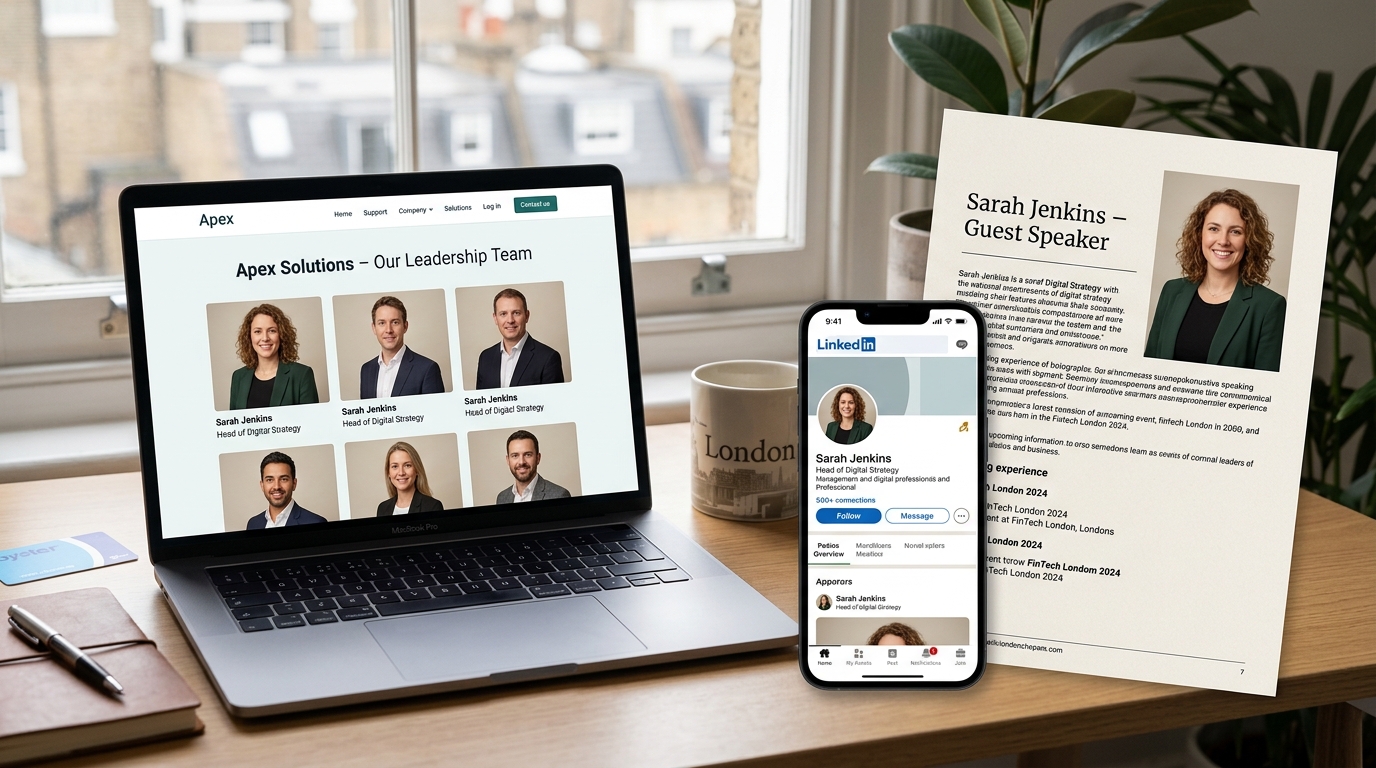
One of the most consistent realisations I see from clients after commissioning professional headshots is that they had underestimated how many contexts a single strong image serves. The same headshot that appears on their LinkedIn profile also appears on the company website, in their speaker biography for a conference, in the press release announcing their promotion, in the author photograph on a thought leadership article, and in the introduction email they send to new clients. A single well-produced image earns its cost many times over across a two to three year deployment period.
Bernardson Photography’s guide to professional image and its commercial return across digital channels2, the average London senior professional uses their primary headshot image across between five and eight distinct digital contexts simultaneously, which means the cost of the headshot is effectively divided across all of those contexts when calculating its commercial return. A professional headshot that costs significantly less than a single billable hour of a senior professional’s time but serves their professional presence across multiple channels for two to three years is not a cost. It is infrastructure.
The cost of not having a professional headshot
The cost of a poor or outdated headshot is harder to calculate than the cost of a professional one because it manifests as missed opportunities rather than direct expenses. A journalist who is considering profiling a London professional and encounters an unflattering or outdated photograph may look for a different subject with stronger visual materials. A conference organiser reviewing speaker submissions for a high-profile event may favour candidates whose professional image communicates the level of polish the event requires. A potential client reviewing a proposal from multiple agencies may not consciously notice the poor headshot but may nonetheless register a lower level of trust in the individual whose professional presentation is the weakest in the comparison.
Team headshots and organisational brand consistency
For organisations with multiple client-facing or publicly visible team members, the quality and consistency of team headshots communicates something specific about the organisation as a whole, not just about the individuals in the images. A company website team page where some members have professional headshots and others have informal photographs or no photograph at all communicates inconsistency and varying levels of investment in professional presentation. A team page where all members have consistent, high-quality professional headshots communicates that the organisation takes its professional identity seriously and invests in presenting its people well. For London professional services firms, technology companies, and financial institutions, this visual consistency is a direct signal of organisational quality to every client, candidate, and journalist who visits the site.
What Specifically Makes a Professional Headshot Different from a Phone Photograph
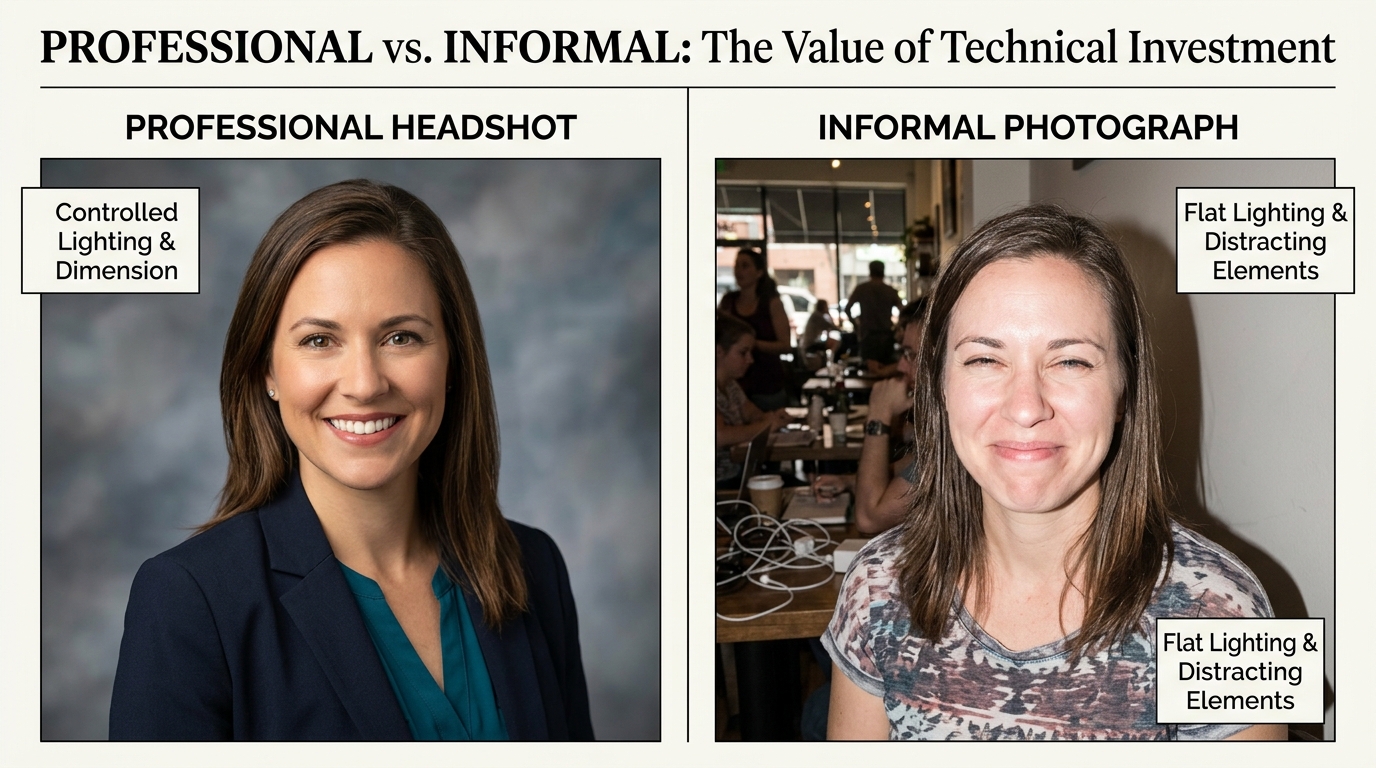
The question I hear most often from professionals who are on the fence about booking a headshot session is whether the difference is really visible enough to justify the cost. The answer is yes, consistently, and the reasons are specific and technical rather than subjective.
Social Tables’ guide to professional portrait photography and its visual impact on professional credibility3, the specific technical elements that distinguish a professionally produced headshot from a phone photograph or informal image are visible to viewers even when those viewers have no technical knowledge of photography. The human perceptual system is exquisitely sensitive to the signals of intentionality and quality that professional photography communicates, even when the viewer cannot articulate what specifically they are responding to. The specific elements include:
Lighting quality and its effect on how a face reads
Professional portrait lighting creates dimension, depth, and a specific quality of skin tone that natural light and phone cameras in uncontrolled environments almost never replicate. A face lit with professional studio lighting has clearly defined shadows that communicate facial structure and presence. A face lit by overhead office fluorescence, a phone’s front-facing flash, or uncontrolled natural light often appears flat, washed out, or colour-distorted in ways that communicate the absence of professional production rather than a specific aesthetic choice. The lighting in a professional headshot is the most visible indicator of production quality and the first signal the viewer receives about the level of investment the subject has made in their professional image.
Expression and direction
The expressions that work best in professional headshots are almost never produced without direction. A self-taken photograph or a casually taken phone portrait captures whatever expression the subject happened to be wearing at the moment of capture. A professionally directed headshot captures an expression that has been specifically drawn out by a photographer who knows how to create the conditions for a natural, warm, and authoritative look. The difference between a directed expression and an undirected one is visible in every element of the face: the eyes, the set of the jaw, the softness or tension around the mouth. A professional headshot session that produces a genuinely natural-looking expression is one where the photographer has worked actively to create that expression rather than simply pointing a camera and hoping for the best.
Background and environmental control
A professional headshot session gives the photographer complete control over the background of the image: the colour, the texture, the degree of blur, and whether it communicates a specific sense of environment or a neutral context. This control is not available in a casual or self-taken photograph, which means the background is whatever happened to be in the frame at the time: an office wall, a crowded networking event, a home environment, or a cluttered street. None of these backgrounds communicates the same level of professional intention as a specifically chosen and professionally lit studio or environmental background. The background communicates the production values of the image before the viewer has even focused on the subject’s face.
How Professional Headshots Serve LinkedIn and Digital Presence Specifically

LinkedIn is the context where the commercial return of a professional headshot is most directly and most consistently measurable, and where the gap between having a professional image and not having one is most commercially significant for London professionals across every industry. The platform is the primary digital touchpoint for professional reputation management, business development, and executive visibility, and the headshot is the first element of every profile that is evaluated.
LinkedIn Business’s research on profile optimisation and professional image performance4 identifies a professional headshot as generating dramatically higher profile view rates than profiles using informal photographs or no photograph, and notes that the headshot’s quality is the primary factor that determines whether a viewer spends more than three seconds on a profile or scrolls past it. For London professionals whose business development, media profile, or career advancement depends on LinkedIn visibility, this is a direct commercial argument for investing in the quality of the image that introduces them to every viewer who encounters their profile.
The circular crop requirement
LinkedIn displays profile photographs in a circular crop, which means that an image not specifically composed for this format may lose significant visual information when displayed on the platform. A headshot where the subject’s head is centred and the shoulders and upper chest are included in the frame survives a circular crop without losing any critical information. A photograph where the subject is to one side of the frame, where the head is cut close at the top, or where the composition relies on elements that appear at the edges of the frame, will be significantly compromised by the circular crop. Telling the photographer that the primary use of the headshot will be LinkedIn allows them to compose specifically for this format from the start of the session.
The thumbnail scale test
LinkedIn profile photographs are displayed at a small size in most contexts: in search results, in connection recommendations, in comment sections, and in the preview pane of messages. A headshot that reads clearly at thumbnail scale, where the face and expression are immediately legible, performs significantly better in these contexts than one that requires a larger display size to communicate its quality. The test for a LinkedIn headshot is whether the subject is immediately recognisable and positively impressive at the size of a postage stamp. If the answer is no, the image is not optimised for the platform it is primarily serving.
Frequently Asked Questions
How much does a professional headshot cost in London and is it worth it?
The cost of a professional headshot session in London varies significantly by photographer, ranging from a few hundred pounds for a focused individual session to significantly more for a full team session with multiple individuals and background options. When evaluating this cost, it is useful to think about the commercial contexts the image will serve and the duration over which it will be deployed. A headshot used across LinkedIn, a company website, a speaker biography, and press materials for two to three years has a cost-per-impression that is lower than almost any other marketing investment available to a London professional. The more visible the professional is digitally, the higher the return on that investment.
Does the quality of a headshot actually affect how people perceive me professionally?
Yes, and the research on this is clear and consistent. Studies in professional psychology and image science consistently find that the quality of a professional photograph affects how viewers assess the subject’s competence, warmth, and credibility, even when viewers are unaware that the photograph’s quality is influencing their judgement. A professional whose headshot communicates high production values is perceived as investing more in their professional identity, which correlates with higher assessments of their competence and commitment. As Photier’s 2025 guide to professional image and credibility perception5, the specific effect of photograph quality on professional credibility assessment is measurable and significant, particularly in contexts where the viewer has no other information about the professional beyond their digital presence.
Can I use the same headshot for LinkedIn and my company website?
Yes, and planning for both uses in the session brief is the most efficient approach. LinkedIn displays images in a circular crop at a relatively small size, which means tight framing on the face and shoulders performs best. Company websites typically display at a larger size and may require a specific aspect ratio. A photographer briefed on both use contexts before the session can produce multiple crops that serve each platform optimally, rather than a single composition that is adapted for one and compromised for the other. Most professional headshot sessions include multiple crop options as standard.
How many outfit changes should I do in a headshot session?
For most professionals, one to two outfits produce a useful library without extending the session to a length that creates fatigue and diminishes the quality of later images. The first outfit should be the primary one: the look that will be used on LinkedIn and the company website. A second outfit provides an alternative that can be used for different contexts, such as a more formal look for press materials and a more relaxed look for internal communications, without requiring a second session. Bringing a third option is sensible as a backup but should not typically be planned as a third distinct look within a standard session.
Should the whole team get headshots at the same time?
For organisations commissioning team headshots for a company website or press materials, a single organised session where all team members are photographed on the same day is significantly more efficient and produces more visually consistent results than commissioning headshots individually at different times. A team headshot session with a consistent lighting setup, background, and direction produces a cohesive set of images that communicates organisational investment and visual care when displayed together. Individual sessions at different times, with different photographers and different setups, almost always produce a team page that looks visually inconsistent regardless of the individual quality of each image. Browse the full headshots and portraits portfolio at eventphotographer.photos, then get in touch via the contact page to discuss your individual or team headshot requirements.
Commission Your Professional Headshots in London
A professional headshot is the highest-return single investment most London professionals can make in their digital presence. It serves every channel where they are visible to potential clients, collaborators, media contacts, and employers. It communicates competence, warmth, and investment in professional identity simultaneously. And it does all of this from a single image that, produced correctly, will work for years across every platform it appears on.
Joel Knight is a London-based headshot and portrait photographer with extensive experience working with professionals across law, finance, technology, media, and professional services. Browse the full headshots and portraits portfolio, the corporate and awards photography portfolio, and the conference photography portfolio at eventphotographer.photos, then get in touch via the contact page to discuss your headshot session.
REFERENCES & CITATIONS
- LinkedIn Business (2023). Professional Image and Audience Engagement: Profile Views and Connection Rates for Headshot vs Informal Photography. business.linkedin.com. Cited in H2 Section 1. [LinkedIn profiles with professional headshots receive significantly more profile views, more connection requests, and more messages than equivalent profiles with informal photographs or no photograph at all.]
- Bernardson Photography (2025). Professional Image and Its Commercial Return Across Digital Channels: Multi-Context Headshot Deployment. bernardson.com. Cited in H2 Section 2. [The average London senior professional uses their primary headshot image across between five and eight distinct digital contexts simultaneously, making the cost of the headshot effectively divided across all those contexts when calculating commercial return.]
- Social Tables (2025). Professional Portrait Photography and Its Visual Impact on Credibility: Technical Elements That Create the Difference. socialtables.com. Cited in H2 Section 3. [The specific technical elements distinguishing a professionally produced headshot from a phone photograph are visible to viewers even when those viewers have no technical knowledge of photography.]
- LinkedIn Business (2023). Profile Optimisation and Professional Image Performance: Headshot Quality and Profile View Rates. business.linkedin.com. Cited in H2 Section 4. [Professional headshot generates dramatically higher profile view rates than profiles using informal photographs, with headshot quality being the primary factor determining whether a viewer spends more than three seconds on a profile.]
- Photier (2025). Professional Image and Credibility Perception: The Measurable Effect of Photograph Quality on Professional Assessment. photier.com. Cited in H2 Section 5 FAQs. [The specific effect of photograph quality on professional credibility assessment is measurable and significant, particularly in contexts where the viewer has no other information about the professional beyond their digital presence.]