
Most internal communications teams in London are running on a constant shortage of good photography. They have a newsletter to fill, an intranet to keep current, an all-staff presentation to illustrate, and an onboarding pack to refresh, and the image library they are working from is either outdated, full of stock photography that nobody believes, or both. The irony is that most of these organisations are running events throughout the year that produce exactly the photography they need. They just are not capturing it with internal communications in mind.
Building an internal communications photography library from your corporate event programme is one of the most cost-effective things a communications or HR team can do. It produces genuine, authentic imagery of real employees in real situations, which performs significantly better across every internal channel than stock photography or outdated headshots. This guide covers how to do it systematically, starting with how to brief your photographer and ending with how to organise and maintain a library that keeps working for your team month after month.
Why Internal Communications Photography Matters More Than Most Teams Acknowledge
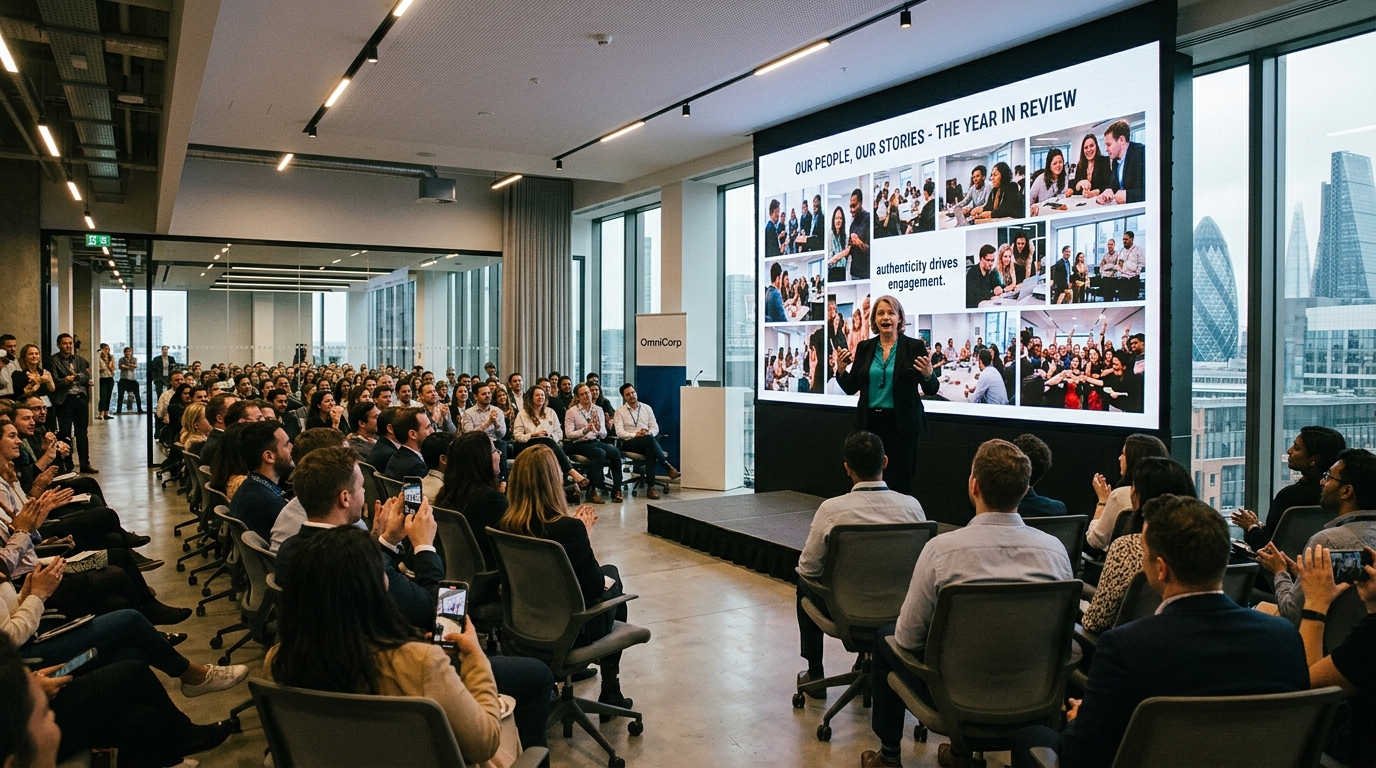
I have photographed internal events for London companies where the communications team told me afterwards that the images were the first genuine employee photography they had used in their internal channels in over two years. Everything before that had been stock photography or phone snapshots. When they switched to professional event photography, the open rates on their internal newsletter increased noticeably in the following months. That is not a coincidence.
As LinkedIn Business’s research on visual content and professional audience engagement1 confirms, content featuring genuine photographs of real people in real working contexts consistently outperforms equivalent content illustrated with stock imagery across every measurable engagement metric. The same principle that applies to external employer brand content applies equally to internal communications. Employees are no more persuaded by generic stock photography of smiling people in offices than candidates are. They recognise it immediately as a placeholder and they engage with the content beneath it at a lower rate as a result.
The commercial case for investing in event photography for HR teams and internal communications is straightforward. The cost of professional photography at a corporate event that the organisation is running anyway is a fraction of the cost of a dedicated internal photography shoot. The images produced serve the communications function across multiple channels and multiple campaigns for twelve months or more. And they communicate something that stock photography structurally cannot: that the organization is real, its people are real, and the culture it describes in its internal communications is genuinely visible in how its employees interact and work together.
Which Corporate Events Produce the Most Useful Internal Communications Photography

In practice, not all corporate events produce equally useful photography for internal communications purposes. The events that generate the most commercially versatile internal photography library are those where employees are genuinely engaged, authentically connected, and visibly invested in what is happening. Formal events with fixed programmes and limited interaction produce strong coverage photography but limited candid content. The events that balance both are the most valuable for internal communications teams.
As Bernardson Photography’s guide to authentic corporate event storytelling2, the most commercially useful internal event photography comes from occasions where the photographer has the freedom to move through the event and capture genuine moments of connection, collaboration, and recognition alongside the formal programme coverage. The specific event types that consistently produce strong company event photos for internal communications use include:
All-staff conferences and town halls
An all-staff event brings the entire organisation together in one space, which means a single shoot day can produce photography that represents every team, every level of seniority, and every location. The wide shots of a well-attended town hall communicate scale and organisational health. The candid moments during breaks communicate genuine culture. The speaker and leadership portraits taken during the event can refresh the executive directory and the senior leadership section of the intranet simultaneously. A well-briefed photographer at an all-staff conference can produce a year’s worth of internal communications photography from a single event.
Learning and development programmes
Photography from L&D events communicates one of the most powerful messages an organisation can send to its current and prospective employees: we invest in you. Images of workshops, external speaker events, leadership programmes, and skills training sessions all contribute to an internal narrative of growth and development that significantly outperforms a sentence in a values statement. For communications teams producing content about career development, employee benefits, or learning culture, L&D photography is the most direct visual evidence available.
Recognition and rewards events
Photography from employee recognition events, whether a formal awards evening or an informal team celebration, communicates the organisation’s commitment to acknowledging individual and team contribution. The images that work best for corporate photography internal use from recognition events are the candid reactions: the colleague being surprised by a recognition moment, the team celebrating a win together, the senior leader congratulating an individual in a genuine rather than staged interaction. These images have a human authenticity that every internal communications manager knows is difficult to produce from a brief and almost impossible to replicate with stock imagery.
Onboarding and new joiner events
New joiner induction events and onboarding programmes are among the most underused sources of internal photography for London companies. A well-photographed onboarding event produces images that communicate welcome, investment, and cultural warmth at the precise moment they are most needed: when a new employee is forming their first impressions of the organisation. Photography from onboarding events also provides current imagery of recent hires that can populate new joiner announcements, the staff directory, and the internal newsletter in the weeks after they join.
How to Brief Your Photographer for Internal Communications Content

The most consistent mistake I see from internal communications teams when they commission a corporate event photographer is assuming that the standard event brief covers their requirements. It does not. A standard event brief produces coverage of the programme. An internal communications brief produces imagery of the people, the culture, and the moments that the programme creates. Those are different creative objectives and they require different instructions.
As Social Tables’ guide to briefing photographers for corporate and HR content3, internal communications photography requires explicit briefing on the specific visual stories the organisation needs to tell and the specific channels the images will appear in. Without this, the photographer defaults to event documentation mode. With it, the photographer becomes an active contributor to the communications programme. The specific briefing additions that shift a standard event commission into an internal communications commission include:
- Share your internal communications calendar. Tell the photographer which internal channels are planned to receive photography from this event and roughly when. A newsletter going out two weeks after the event needs web-optimised images sized for the newsletter template. An intranet refresh has specific image dimension requirements. A town hall presentation needs wide images that work on a projector screen. Knowing the destination shapes the composition.
- Name the internal stories you need to tell. Internal communications teams are always working on specific narratives: we invest in our people, our leadership is accessible, our culture is collaborative, our teams celebrate together. Name these stories in the brief and ask the photographer to look for moments that illustrate each of them during the event. This is the difference between a photographer who covers what happens and one who looks for what you need.
- Request a specific candid coverage ratio. For internal communications use, the ratio of candid to formal photography typically needs to be higher than for a standard event library. A brief that specifies at least sixty percent candid, unposed coverage gives the photographer permission to move through the event and capture genuine moments rather than spending the majority of the day on formal programme coverage.
- Include the staff directory as a deliverable. Every corporate event that brings a significant number of employees together is an opportunity to update individual employee photographs for the internal directory. Including clean individual portraits as an explicit deliverable in the brief, with a simple process for the photographer to match names to faces on the day, produces a staff directory refresh that would otherwise require a separate, dedicated headshot session.
• Agree the internal filing structure before delivery. An image library delivered in a flat folder of two hundred unlabelled files is significantly less useful than a library organised by event section, by individual, or by intended channel. Agreeing on the filing structure at briefing stage means delivery is immediately usable rather than requiring hours of internal organization before the images can be deployed.
Organising and Maintaining Your Internal Communications Photography Library

In practice, the internal communications teams that get the most sustained value from their corporate event photography are not those with the biggest libraries. They are those with the most organised ones. A library of five hundred images organised by event, by subject, and by intended use is significantly more valuable than a library of two thousand images dumped in a single shared folder that nobody can navigate efficiently.
As Retines Photography’s guide to corporate photography library management and deployment4, the organisations that maintain the strongest internal visual content programmes are those that treat the image library as a managed asset with a defined structure, a regular refresh schedule, and clear ownership rather than an ad hoc folder that grows without governance. The specific practices that make an internal photography library commercially sustainable include:
A folder structure organised by use, not by event
The most common internal library structure organises images by event: All Staff Conference 2024, Summer Party 2024, Leadership Offsite 2025. This is logical from an archival perspective but frustrating from a communications perspective, because when a newsletter editor needs an image of people collaborating they have to search across multiple event folders rather than going directly to a collaboration folder. A use-based folder structure, with event date subfolders within each use category, serves the communications function far better. Suggested top-level folders: Leadership and Presentations, Team Collaboration, Recognition and Celebrations, Learning and Development, Social and Culture, Individual Portraits.
A rolling six-month refresh cycle
Internal photography ages faster than external photography because employees notice when the images in company communications are outdated. A photograph of a team that has changed significantly, a leader who has left, or an office that has been refurbished communicates carelessness rather than culture. Building a six-month library review into the communications calendar, tied to the organisation’s event programme, ensures that imagery is refreshed regularly rather than left to age until someone complains.
A consent and permissions log
For internal communications photography that will be used in external-facing materials such as the careers page, LinkedIn, or press releases, individual consent records are important. Maintaining a simple log that records which employees have consented to external use of their images, alongside their photo file names, eliminates the audit risk that arises when communications teams are unable to confirm consent for specific individuals in images already published externally.
A brief template for future commissions
Once you have built an internal communications brief that produces the imagery your channels need, preserve it as a template for future commissions. The photographer changes, the event changes, but the internal communications requirements of the organisation are relatively stable. A brief template that specifies the channels, the stories, the candid ratio, the portrait deliverable, and the filing structure means every future commission starts from a position of clarity rather than requiring the briefing process to be rebuilt from scratch each time.
Frequently Asked Questions
How often should a London company commission internal communications photography?
In practice, the most effective approach is to commission professional photography at every significant internal event rather than scheduling dedicated photography shoots as separate budget items. An all-staff conference, a major recognition event, a large team away day, and a senior leadership offsite are all events that produce internal communications photography as a by-product of professional event coverage. Treating photography as a standard deliverable from every event of this type, rather than an optional add-on, produces a continuously refreshed library at a fraction of the cost of dedicated shoots. For a London company running four to six significant internal events per year, this approach produces enough fresh imagery to sustain a full annual internal communications programme.
Can the same photographer cover both our internal events and our external-facing conferences?
Yes, and there are significant advantages to using the same photographer across both internal and external commissions. Consistency of visual style across internal and external photography produces a coherent visual identity that makes the organisation look more considered and professional across every touchpoint. A photographer who has covered your internal events understands your culture, your people, and your organisation’s visual character in a way that a photographer brought in for a single external commission does not. This familiarity shows up in the quality of the candid and portrait photography in particular, where the comfort of the subjects with the photographer significantly affects the authenticity of the images.
What is the best format for delivering internal communications photography?
As Neurapix’s guide to professional photography delivery formats for corporate clients5, the most useful delivery format for corporate photography internal use includes three components: full-resolution files for print and large-format digital use, web-optimised files for newsletter and intranet use pre-sized to the organisation’s standard image dimensions, and individual portrait crops where individual headshots were part of the commission. Receiving all three as part of a standard delivery eliminates the post-delivery image processing that internal teams often spend hours on when only full-resolution files are provided.
Should internal events be photographed differently from external-facing events?
The technical approach is the same. The creative brief is different. Internal events benefit from a higher proportion of candid, unposed photography because authenticity is what makes internal content credible to employees who were not at the event. External events typically require more formal programme coverage because the primary audience has not experienced the event and needs the formal elements documented. A photographer who understands both contexts can adjust their coverage approach accordingly when briefed clearly on the distinction. The brief, not the event type, is what determines the output.
How should we handle employees who do not want to be photographed at internal events?
A simple opt-out process is the most respectful and most practical approach. Include a note in the event invitation confirming that professional photography will be taking place and providing a clear opt-out mechanism, typically a reply to the invitation or a pre-event registration form field. Share the list of opt-out employees with the photographer before the event so they can avoid including those individuals in any images. In practice, the number of opt-outs at a well-communicated internal event is very small. The most important thing is that the process exists and is communicated before the event rather than managed reactively when an employee objects after the fact. Browse the full corporate and awards photography portfolio at eventphotographer.photos and then get in touch via the contact page to discuss how professional event photography can support your internal communications programme.
Build Your Internal Communications Photography Library with a Specialist
A well-organised internal communications photography library is not a luxury for large organisations with dedicated communications budgets. It is a practical asset that any London company running a regular event programme can build systematically, at no additional cost to the events themselves, by briefing professional photography correctly and deploying the images with a plan. The difference it makes to the quality and engagement of internal communications is significant and measurable.
Joel Knight is a London-based corporate event photographer with extensive experience working alongside internal communications and HR teams to produce imagery that serves both the event record and the internal content programme. Browse the full corporate and awards photography portfolio, the conference photography portfolio, and the headshots and portraits portfolio at eventphotographer.photos, then get in touch via the contact page to discuss your internal communications photography brief.
REFERENCES & CITATIONS
- LinkedIn Business (2023). Visual Content and Professional Audience Engagement: Authentic Photography vs Stock Imagery Performance. business.linkedin.com. Cited in H2 Section 1. [Content featuring genuine photographs of real people in real working contexts consistently outperforms equivalent content illustrated with stock imagery across every measurable engagement metric.]
- Bernardson Photography (2025). Authentic Corporate Event Storytelling: Photography That Serves Internal Communications. bernardson.com. Cited in H2 Section 2. [Most commercially useful internal event photography comes from occasions where the photographer has freedom to move through the event and capture genuine moments of connection, collaboration, and recognition.]
- Social Tables (2025). Briefing Photographers for Corporate and HR Content: Moving from Event Record to Communications Asset. socialtables.com. Cited in H2 Section 3. [Internal communications photography requires explicit briefing on specific visual stories the organisation needs to tell and the specific channels images will appear in.]
- Retines Photography (2025). Corporate Photography Library Management: Organisation, Refresh Cycles, and Deployment. retines.fr. Cited in H2 Section 4. [Organisations maintaining the strongest internal visual content programmes treat the image library as a managed asset with defined structure, regular refresh schedule, and clear ownership.]
- Neurapix (2025). Professional Photography Delivery Formats for Corporate Clients: Full Resolution, Web Optimised, and Portrait Crops. neurapix.com. Cited in H2 Section 5 FAQs. [Most useful delivery format for corporate photography internal use includes full-resolution files, web-optimised files pre-sized to standard dimensions, and individual portrait crops as standard deliverables.]