
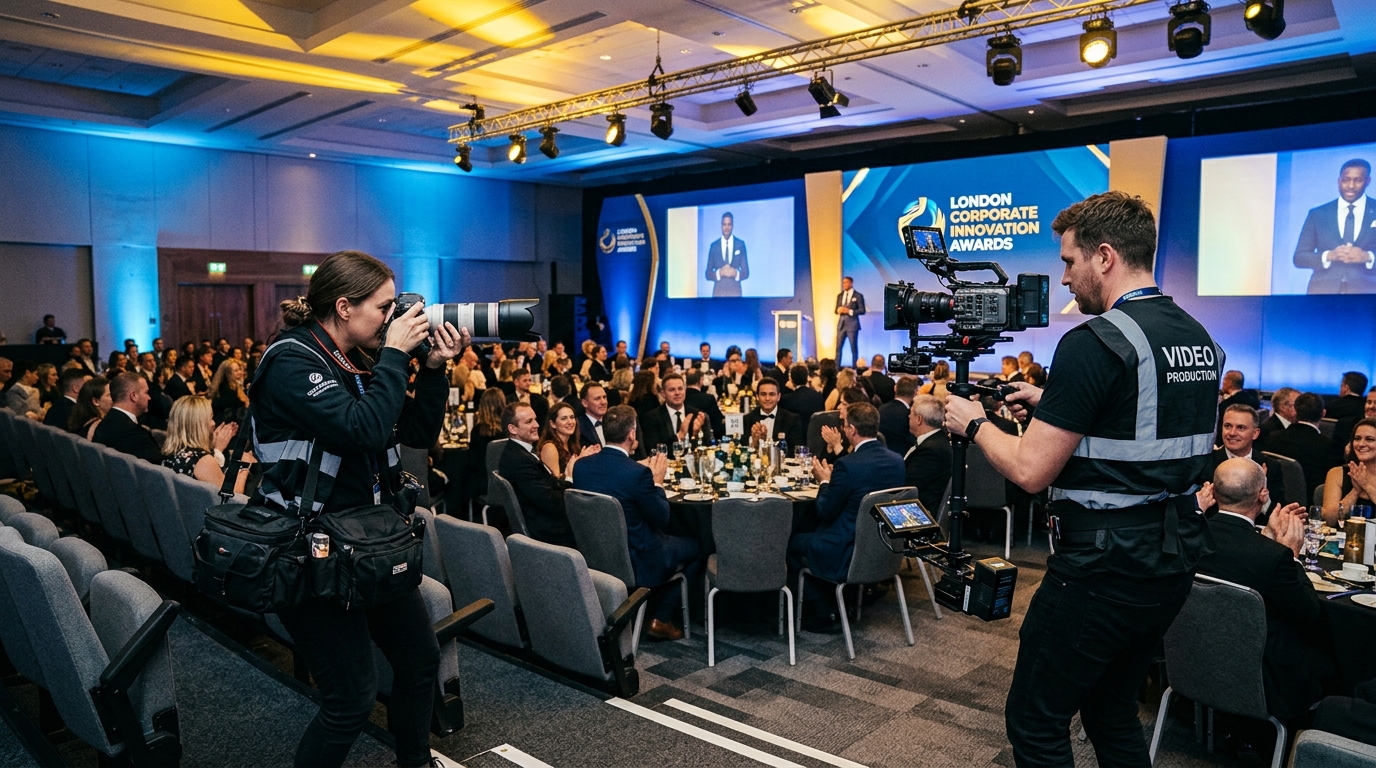
The question of whether to commission photography or videography for a corporate event is one that most London marketing managers and event organisers approach as a budget allocation problem. They have a production budget, they need content from the event, and they are trying to decide how to split the available money between the two disciplines. In my experience, that framing produces the wrong answer almost every time, because it treats photography and videography as competing alternatives when they are actually complementary tools that serve different commercial purposes and different audience contexts.
The better question is not photography or videography. It is: which content types does this event need to produce, which channels will they appear on, and which disciplines produce the assets that serve those channels most effectively? The answer to that question tells you whether to commission photography, videography, both, or neither and instead use AI video from the photography library as a cost-effective third option. This guide provides the framework for making that decision clearly.
What Photography Produces That Videography Cannot
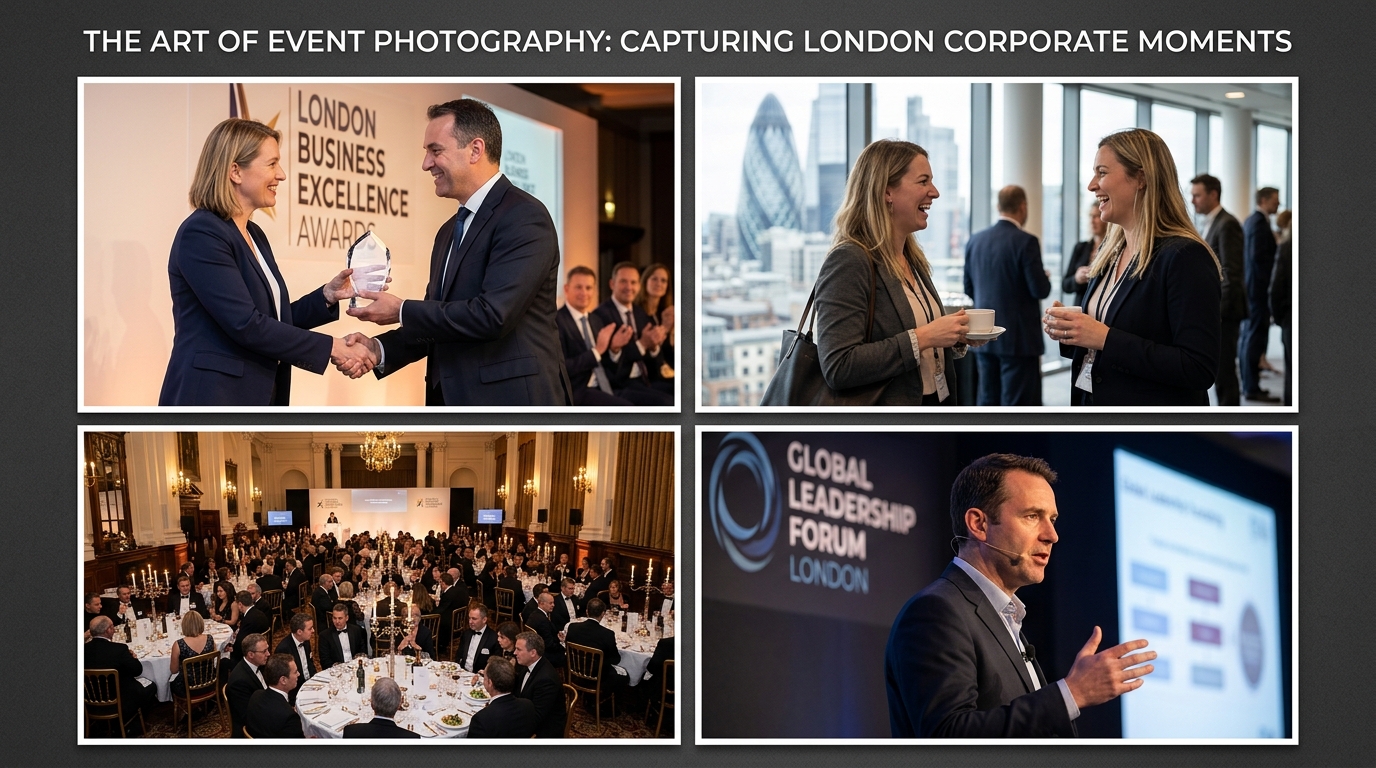
Photography and videography are not the same discipline applied to different time formats. They make fundamentally different visual arguments and produce fundamentally different commercial assets. Understanding what photography does uniquely that videography cannot replicate is the starting point for deciding which your event requires.
Photier’s 2025 guide to event content production and the distinct commercial strengths of photography versus video1, the commercial strengths of professional event photography that video cannot replicate include the ability to produce a single definitive image of a moment, the technical quality required for large-format print reproduction, the compositional control that produces press-ready editorial images, and the versatility of a static image library across a wider range of deployment contexts than video. Specific commercial outputs that require photography rather than video include:
- Press and editorial publications. Newspapers, trade publications, and online news platforms run photographs alongside their stories. They do not embed video in the body of a print publication or in a standard editorial news article. The press image from a corporate event, the trophy handover, the partnership announcement, the product launch moment, is a photography deliverable. A video highlight reel serves no purpose for a journalist writing a story that will be published with a single still image.
- Streaming platform artwork and film marketing materials. As covered in the unit stills discussion earlier in this series, the thumbnail images, key art, and character portraits that populate streaming platforms and film marketing campaigns are still photographs produced to specific resolution and format standards. A videographer captures footage. A unit stills photographer captures the images that market what the footage shows.
- LinkedIn profiles, company websites, and professional directories. A corporate headshot, a team page portrait, and a personal professional profile all require still photography. Video cannot serve the LinkedIn profile image, the company website team grid, or the press biography portrait. These are photography deliverables without exception.
- Award entries and formal submissions. Industry award submissions, annual reports, and formal publications all require still images at specific resolutions and aspect ratios. A video highlight reel cannot be submitted in place of a photography library for these purposes.
• Print and large-format materials. Exhibition stands, event programmes, printed collateral, and large-format displays all require high-resolution still photographs. Video frames extracted at print resolution are almost never sufficient for professional print use, which is why unit stills photography exists as a separate discipline from video production even on the same productions.
What Videography Produces That Photography Cannot
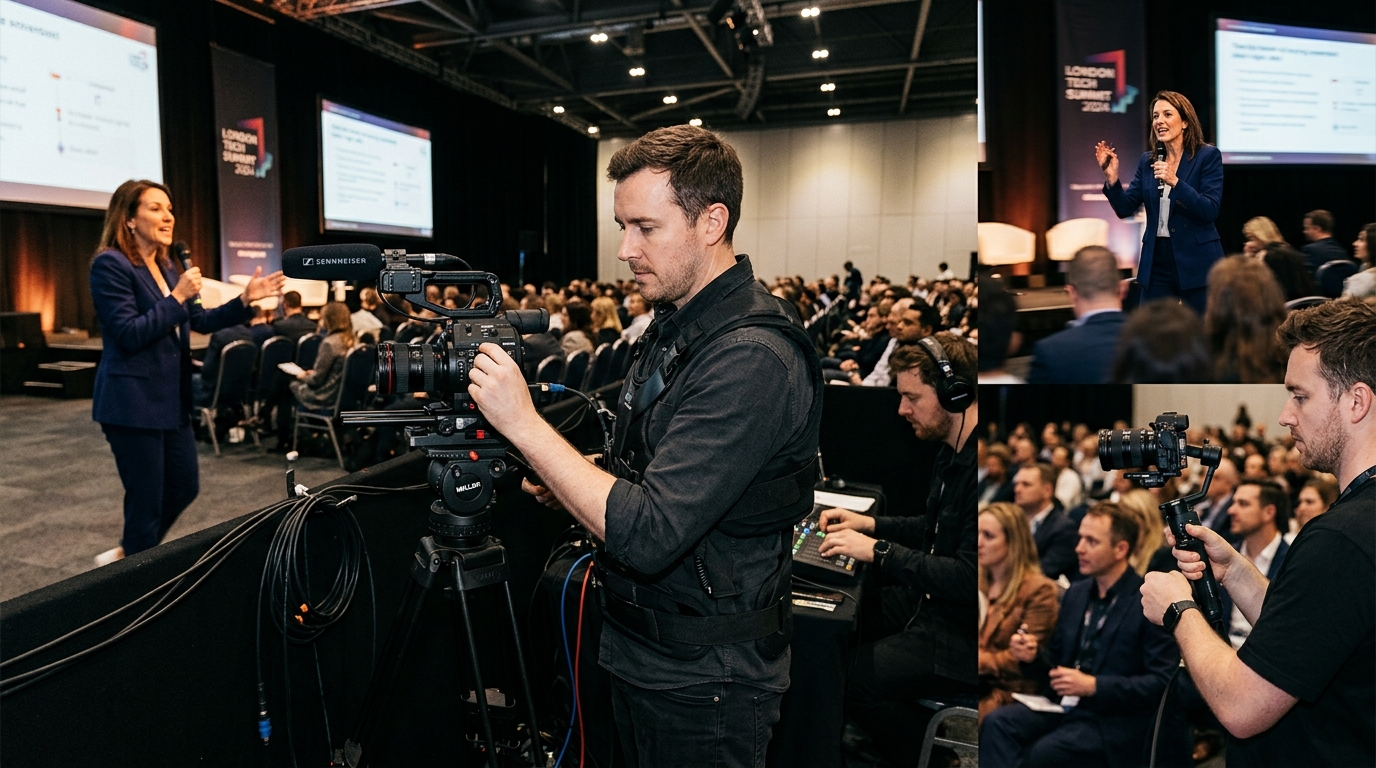
Video is not a better version of photography. It is a different medium with different strengths and different commercial applications. The specific things that video does that photography structurally cannot include capturing sound, communicating movement over time, and creating the emotional experience of being at the event rather than seeing a single moment from it. These are not small differences. They are the reason why some content requirements can only be served by video.
Bernardson Photography’s guide to the complementary commercial strengths of event photography and videography2, the commercial outputs that require videography and cannot be produced from photography alone include speaker content, the authentic atmosphere and energy of an event experienced in real time, and any content where the audience needs to hear as well as see what happened. Specific commercial outputs that require video rather than photography include:
- Speaker and keynote content for distribution. If a conference speaker’s presentation needs to be distributed to an audience who was not present, video is the only format that preserves the full experience: the delivery, the energy, the interaction with the audience, and the content of the speech itself. A still photograph of a speaker at a podium communicates that a presentation happened. A keynote video communicates what the presentation was.
- Event atmosphere and energy for social media. Some events have an atmosphere that is entirely lost in still photography. A live music performance, a highly interactive workshop, an audience reacting with sustained applause, a conference room erupting in laughter at a speaker’s moment: these are experiences that photography can document but cannot convey. Video captures the duration and the sound that photography records only as a frozen instant.
- Internal training and communications content. If the purpose of an event includes training, knowledge transfer, or information that employees need to access after the event, video recording of the sessions is the appropriate format. A photography library of an all-staff training day documents that the training occurred. A video library of the training sessions allows employees who were not present to access the content.
- Broadcast, streaming, and television contexts. Any event content that will be broadcast, streamed live, or submitted for television use requires video capture. Photography has no role in these distribution contexts. A corporate conference broadcast to remote employees, a product launch live-streamed to a global audience, or a brand event filmed for broadcast advertising all require professional video production as their primary content deliverable.
A Decision Framework: Which Does Your Event Actually Need?

Rather than defaulting to a general instinct about which format is better, the most reliable way to make the photography versus videography decision for a specific event is to work through the content requirements systematically. In practice, when I ask clients this question in a pre-event conversation, the answer almost always becomes clear within five minutes of identifying the specific content assets the event needs to produce.
Social Tables’ guide to event content planning and photography versus video commissioning decisions3, the most reliable decision framework for choosing between event photography, videography, and combined coverage involves answering four specific questions about the event’s content requirements before any commissioning decisions are made. These questions are:
Question one: What channels will the event content appear on?
List every digital and print channel where the event content will be published or shared. LinkedIn posts, the company website, press releases, internal newsletters, the annual report, streaming platforms, broadcast television, social media Reels, printed programmes, exhibition stands. For each channel, identify whether the primary content format required is a still image, a video, or both. A channel list that is predominantly still-image contexts points toward photography as the primary investment. A list that is predominantly video contexts points toward videography. A mixed list suggests both are required, and the budget allocation should reflect the relative weight of each format’s channel presence.
Question two: What is the most important single deliverable from this event?
For a corporate awards evening, the most important single deliverable is almost always a press image of the trophy handover: a still photograph. For an all-staff conference broadcast to remote employees, the most important single deliverable is almost always the keynote video: a video production. For a product launch with a press and social media campaign, the most important single deliverable may be either a hero press image or a social highlight reel depending on the priority channel. Identifying the single most important deliverable first ensures the production budget is invested in the discipline that serves it rather than split evenly between two disciplines where one is more critical than the other.
Question three: What is the content deployment timeline?
Photography is deployable immediately: a professional event photographer can deliver an edited selection within 24 to 48 hours and a same-day priority selection within hours. Traditional video production takes three to seven days to deliver a finished edit. If the event content needs to be published the day after the event, or on the day itself, and a traditional video production timeline cannot serve that requirement, the choice between investing in stronger photography coverage or adding AI video production to the photography commission is more commercially effective than investing in traditional videography that will not be ready in time.
Question four: What is the audience’s primary expectation of the content?
A client who has attended a conference and receives a photography library understands and values what they have received. A client whose primary engagement with the event content will be through social media has an expectation set by the platforms they use, where short video content is the dominant format. An internal audience receiving post-event communications from a town hall has an expectation shaped by how those communications have been produced before. Matching the content format to the audience’s expectation of that content is one of the most reliable ways to ensure the investment produces genuine commercial return.
When to Invest in Both Photography and Videography
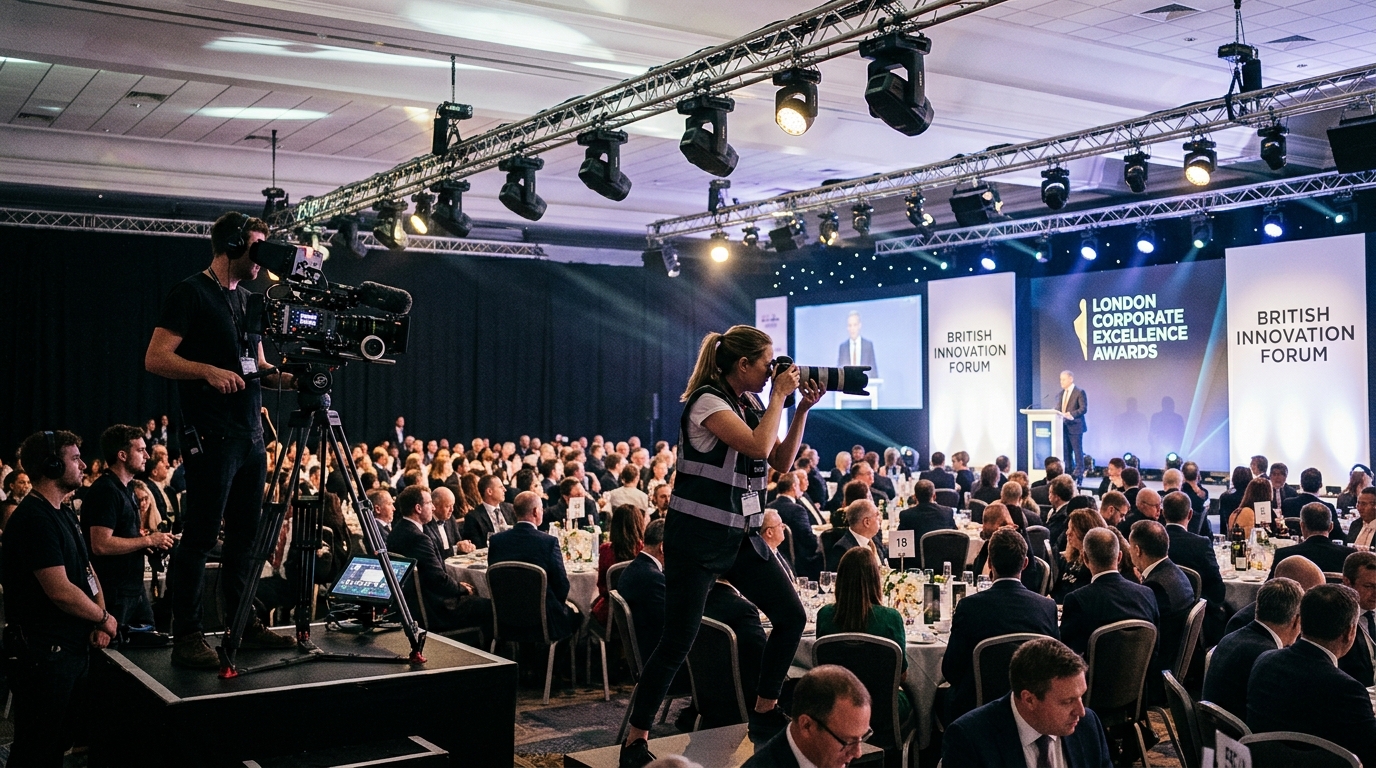
There is a category of event where the honest answer to the photography versus videography question is both, and the budget should reflect that rather than compromising one discipline to partially fund the other. These are events where the content requirements include both still image deliverables that cannot be produced from video and motion content deliverables that cannot be produced from photography.
Retines Photography’s 2025 guide to combined event photography and videography production for corporate clients4, the event contexts that most consistently justify combined photography and videography investment are those with a complex, multi-channel content programme where still images serve one set of channels and video content serves a distinct second set, and where the commercial value of both sets of content is high enough to justify the additional production cost. The specific event types that most regularly warrant combined investment in London include:
- Major corporate conferences with press, social, and broadcast requirements. A large annual conference attended by media, broadcast-streamed to remote employees, and covered in trade publications requires both a professional photographer producing press-quality editorial images and a video production team capturing the keynote content for distribution and broadcast. Neither discipline alone serves all three requirement types.
- Film and television productions requiring both unit stills and footage. As covered in the unit stills and BTS sections of this blog series, film and television productions require both a unit stills photographer producing still images for marketing, press, and streaming platform use and a cinematography team capturing the footage that those still images will eventually market. These are distinct disciplines serving distinct and non-interchangeable purposes.
- Awards evenings with sponsor visibility requirements and broadcast distribution. A major industry awards evening where sponsors expect photography for their own communications, winners need professional portrait images, the ceremony needs to be archived as video, and the highlights need to be published on social media within hours of the event ending has content requirements that span the full range of both disciplines. Commissioning both, with a clear brief for each and a delivery plan that serves each channel, produces the strongest commercial result.
- Product launches with press and social video simultaneous requirements. A product launch where the primary press deliverable is a still image for trade and consumer publications, the primary social deliverable is a sixty-second highlight reel, and the primary brand communications deliverable is a three-minute brand film requires all three content types from a single event. AI video production from the photography library can substitute for traditional videography in the social content context, which reduces the cost of serving all three requirements without commissioning a full traditional video production alongside the photography.
Frequently Asked Questions
Is videography always more expensive than photography for events?
Not always, but on average, yes. Professional event videography requires more equipment, a higher minimum crew, and significantly more post-production time than event photography, which typically results in a higher day rate and a higher post-production fee. A traditional event video production that delivers a polished three to five minute highlight reel involves camera equipment, audio equipment, a multi-day editing process, colour grading, audio mixing, and typically a final review and approval cycle. A professional event photography commission with same-day priority delivery involves a single photographer, a shorter post-production window, and significantly less technical infrastructure. The cost differential is real and should be factored into the budget allocation decision explicitly rather than assumed to be negligible.
Can a single professional cover both photography and videography at an event?
In theory, and on small-scale events where the content requirements are modest, a hybrid operator with both photography and video skills can cover both. In practice, for events where the quality of both disciplines matters commercially, combining them in a single operator almost always produces a compromise. A photographer focused on capturing the definitive still moment from a trophy handover is not simultaneously positioned and framing for a smooth video capture of the same moment. A videographer holding a steady wide shot of a keynote speaker cannot simultaneously move through the room capturing candid networking portraits. The two disciplines require different positions, different equipment configurations, and different creative approaches that are in tension with each other when applied simultaneously from a single operator. For events where both photography and video quality matter commercially, commissioning two specialists produces consistently better results than commissioning one generalist.
Can AI video from photography replace videography for my event?
For social-format event content, yes, in most cases. For keynote recording, broadcast distribution, internal training archives, and any context where the audience needs to hear as well as see what happened, no. AI video from photography is a powerful tool for producing engaging social media highlight content without commissioning traditional videography. It is not a tool that can substitute for live video capture in contexts where authentic movement and sound are required. As Neurapix’s guide to AI video from photography versus live event videography: honest capability comparison5, the commercial value of AI video as a substitute for traditional videography is highest in contexts where social-format short-form content is the primary video deliverable and lowest in contexts where the video content needs to serve broadcast, archival, or educational purposes where sound and authentic motion are essential elements of the viewing experience.
What should I prioritise if I can only afford one discipline?
Start with photography. A professional event photography library serves a wider range of content channels, deploys more quickly, and has a longer commercial lifespan than a video production of comparable investment. It serves press, social media, internal communications, annual reports, website, and professional profiles simultaneously. If social video content is also a requirement, AI video production from the photography library adds that capability at a fraction of the cost of commissioning traditional videography alongside the photography. The combination of professional event photography and AI video production consistently produces more commercial value per pound invested than either professional photography alone or professional videography alone for most corporate events in London.
How do I brief both a photographer and videographer working at the same event?
The most important element of briefing both disciplines at the same event is establishing which moments are photography priorities, which are video priorities, and which require both, before the event begins rather than allowing both operators to compete for position at the most important moments. A joint pre-event briefing where both the photographer and videographer are present and the coverage plan is agreed together produces a complementary coverage approach where each operator knows their primary responsibilities and the positions they need to hold for the moments that matter most. An event where both operators are briefed separately and independently often produces a day where both are in each other’s frames, both are positioned identically for priority moments, and neither produces the coverage quality their brief required. Browse the full conference photography portfolio, the corporate and awards photography portfolio, the AI video production portfolio, and the unit stills and BTS portfolio at eventphotographer.photos, then get in touch via the contact page to discuss your event’s content production requirements.
Commission Your Event Content Production in London
Photography and videography are not competing for the same budget. They are serving different commercial purposes, and the most effective event content production investment is one that starts with a clear understanding of which content types the event needs to produce, which channels those content types will serve, and which disciplines produce them at the quality each channel requires.
Joel Knight is a London-based event photographer covering conferences, awards evenings, corporate events, PR and editorial photography, headshots, unit stills, BTS production photography, and AI video production across London and the UK. Every commission begins with a content planning conversation that identifies the right combination of disciplines for the specific event and the specific channels the content needs to serve. Browse the full conference photography portfolio, the corporate and awards photography portfolio, the AI video production portfolio, and the unit stills and BTS portfolio at eventphotographer.photos, then get in touch via the contact page to discuss your event.
REFERENCES & CITATIONS
- Photier (2025). Event Content Production and the Distinct Commercial Strengths of Photography Versus Video. photier.com. Cited in H2 Section 1. [The commercial strengths of professional event photography that video cannot replicate include the ability to produce a single definitive image of a moment, technical quality required for large-format print reproduction, and versatility across a wider range of deployment contexts than video.]
- Bernardson Photography (2025). Complementary Commercial Strengths of Event Photography and Videography: What Each Produces Uniquely. bernardson.com. Cited in H2 Section 2. [The commercial outputs that require videography and cannot be produced from photography alone include speaker content, the authentic atmosphere and energy of an event in real time, and any content where the audience needs to hear as well as see what happened.]
- Social Tables (2025). Event Content Planning and Photography vs Video Commissioning Decisions: A Four-Question Framework. socialtables.com. Cited in H2 Section 3. [The most reliable decision framework for choosing between event photography, videography, and combined coverage involves answering four specific questions about the event’s content requirements before any commissioning decisions are made.]
- Retines Photography (2025). Combined Event Photography and Videography Production for Corporate Clients: When Both Are Justified. retines.fr. Cited in H2 Section 4. [Event contexts that most consistently justify combined photography and videography investment are those with a complex multi-channel content programme where still images serve one set of channels and video serves a distinct second set.]
- Neurapix (2025). AI Video from Photography vs Live Event Videography: Honest Capability Comparison. neurapix.com. Cited in H2 Section 5 FAQs. [The commercial value of AI video as a substitute for traditional videography is highest in contexts where social-format short-form content is the primary deliverable and lowest in contexts where broadcast, archival, or educational purposes require sound and authentic motion.]