
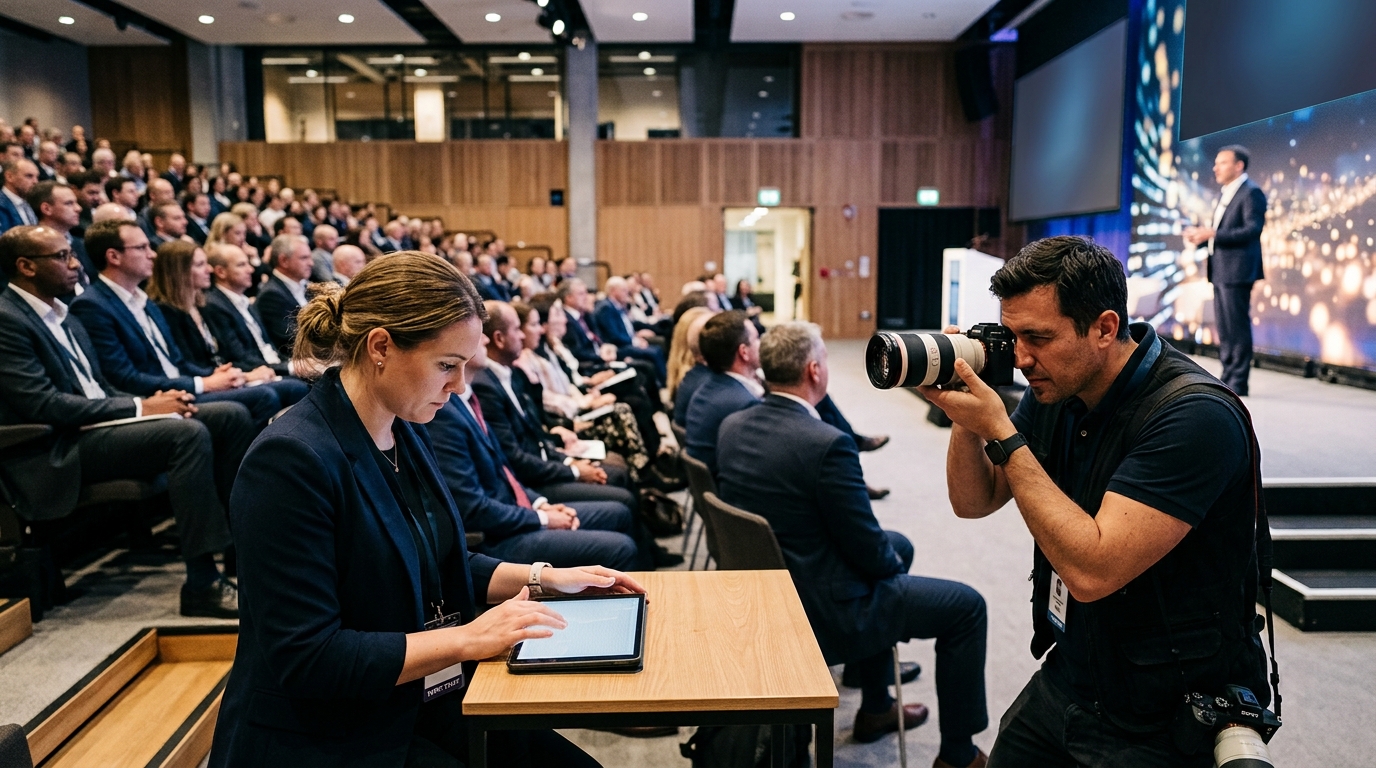
Most businesses do not think about event photography usage rights until the photographs have already been delivered. Then the questions start. Can the marketing team put them on the website? Can the PR agency send them to journalists? Can a keynote speaker use the images on LinkedIn? Can a sponsor use them in an advert? Does paying the photographer mean the company owns the copyright?
Those questions matter because buying event photography and buying copyright are not automatically the same thing under UK law. In most professional commissions, the photographer creates the images and the client receives a licence defining how those images can be used. The exact scope of that licence can be broad or narrow, and it should be understood before the photographs are distributed to colleagues, agencies, speakers, sponsors or partners.
There is also a second issue that is often confused with copyright: the rights and privacy of identifiable people appearing in photographs. Copyright deals mainly with ownership and use of the image as a creative work. Data protection and privacy deal with how personal information about identifiable individuals is collected and used. A business event can involve both at the same time.
This guide explains the practical framework for event photography usage rights in the UK from a business client’s perspective. It is general information, not legal advice. If a campaign has unusual licensing, advertising, privacy or contractual requirements, those should be reviewed with the photographer and, where appropriate, a qualified legal or data-protection professional before publication.
Who Owns the Copyright When a Business Hires an Event Photographer?
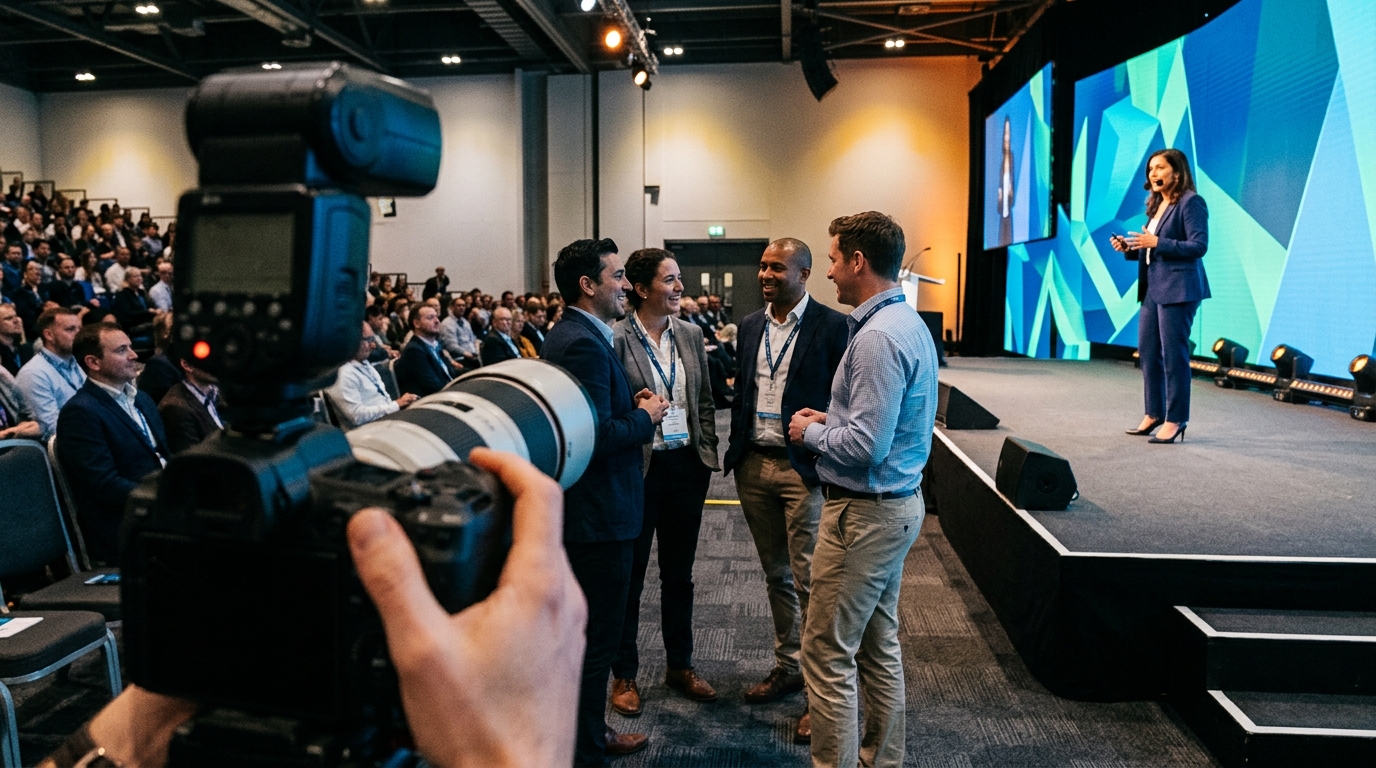
The starting point is ownership. GOV.UK guidance on ownership of commissioned copyright works1 states that when a person or organisation commissions another party to create a copyright work, the creator is generally the first legal owner unless the parties agree otherwise in writing.
For a freelance event photographer, that normally means the photographer or photography business owns the copyright in the images they create. Paying an invoice does not, by itself, transfer that copyright to the client. What the client normally purchases is the photography service plus permission to use the resulting images within agreed terms.
The Intellectual Property Office’s guidance on digital images and photographs2 makes the same distinction: the creator of an image will generally be the first copyright owner, and a commissioned client may receive a licence rather than ownership unless copyright has been transferred by agreement.
This is important for corporate teams because the operational question is rarely ‘Who owns the file sitting on our server?’ The better question is ‘What are we allowed to do with this image?’ A company may have very broad usage rights without owning the copyright at all. In many cases, that is exactly what the client needs.
For example, a licence may allow a business to use its event photographs indefinitely on its own website, LinkedIn, press releases, newsletters, internal communications and organic PR. That can give the organisation extensive practical freedom while the photographer continues to hold the underlying copyright.
The position can be different where the photographer is an employee creating images in the course of employment, where a written contract assigns copyright, or where older photographs are governed by historic rules. For a modern commercial event commission, the safest approach is to read the agreement rather than assume that payment equals copyright ownership.
Copyright Ownership and an Event Photography Licence Are Not the Same Thing
GOV.UK guidance on using somebody else’s copyright3 explains that a user normally needs permission through a licence, ownership of the copyright, or a relevant legal exception before carrying out acts controlled by copyright.
A licence is therefore the practical bridge between the photographer’s copyright and the client’s need to publish the images. It can be tailored around the channels, territory, duration and commercial purpose agreed between the parties.
GOV.UK guidance on licensing and selling copyright4 distinguishes licensing from assignment: a copyright owner can license use while retaining ownership, whereas a transfer of copyright requires a written, signed document.
For most event clients, a broad licence is usually more relevant than a full copyright assignment. A marketing team wants confidence that it can use the images in the ways required by the campaign. It does not necessarily need to acquire every underlying intellectual-property right in the photographs.
The distinction becomes important when a client later wants to extend the use beyond the original brief. A conference gallery commissioned for internal communications and organic PR may later be selected for a national paid advertising campaign. A sponsor may ask to use a photograph in its own promotional material. A speaker may want the image for a commercial book cover. Those uses may sit outside the original licence even though the client legitimately possesses the files.
This is why the booking agreement should be treated as part of the creative brief, not as paperwork to ignore until a problem appears. The clearer the intended use is before the shoot, the easier it is to price and document the correct licence from the beginning.
Joel Knight’s Event Photography FAQs currently explain that standard licensing includes unlimited personal, internal business, editorial and organic PR use, while advertising or extended usage can require an upgraded licence. That is the type of distinction a business should confirm before commissioning or republishing images.
What Should an Event Photography Usage Licence Cover?

The Intellectual Property Office’s licensing guidance5 describes a licence as an agreement that gives another party permission to do something that would otherwise infringe the intellectual-property right. For event photography clients, the value is in making that permission specific enough to match real-world use.
A useful event photography licence should answer practical questions rather than rely on vague phrases such as ‘full usage’. The following points are the ones marketing, PR and event teams should understand.
Who can use the photographs?
Is permission limited to the commissioning company, or can its PR agency, parent company, subsidiaries, speakers, sponsors or event partners also receive and publish the files? A client licence does not automatically become a licence for every third party who receives an image.
Where can the photographs appear?
Typical channels include company websites, organic social media, press releases, internal communications, annual reports, event recaps, newsletters and editorial coverage. Paid advertising, packaging, merchandise, billboards or other high-value commercial uses may be treated differently.
How long does the permission last?
Some licences are time-limited while others allow ongoing use. Businesses building long-term content libraries should know whether an image can still be used in a future annual report or event campaign several years after the original commission.
Is the licence geographically limited?
A London event may produce images used globally by an international organisation. If the company expects worldwide use, that should be clear in the agreement rather than assumed later.
Can the images be edited or adapted?
Marketing teams routinely crop event photographs for website banners, social formats and email headers. More substantial alteration, compositing or use in derivative advertising creative may require clearer permission depending on the contract.
IPO guidance on the economic rights granted by copyright6 explains that copyright gives the owner control over acts such as reproducing a work. That is why apparently simple actions such as copying an image into a new campaign or supplying it to another organisation should be checked against the licence rather than assumed to be unrestricted.
If budget and licensing scope need to be planned together, review the Event Photography Pricing & Rates page before requesting a quote. It states that current event packages include in-house and PR usage, while the final agreement should still be checked for the specific commission.
Can Businesses Use Event Photos for PR, Social Media, Advertising and Third Parties?
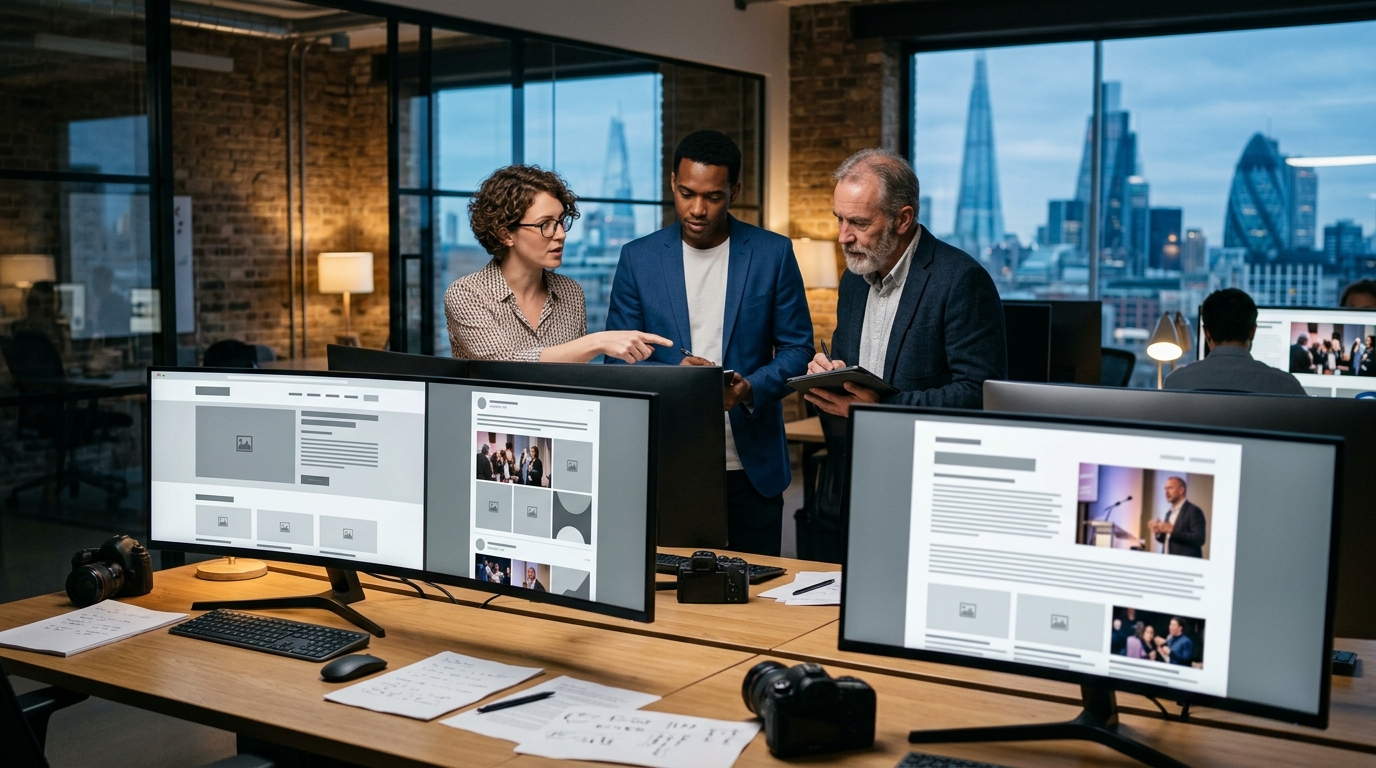
This is where most real-world licensing questions appear. A marketing team receives an excellent gallery and naturally wants to get as much value from it as possible. That is sensible, but each new use should still fit the permission granted.
GOV.UK guidance on photographs and images used online and on social media7 notes that photographs found or shared online remain protected by copyright and that specific permission or an applicable licence is normally needed for reuse. Posting an image publicly does not make it free for everyone else to copy.
Organic social media and company websites
These are common business uses and may be included in a standard corporate or PR licence. Confirm whether the permission covers the organisation’s own channels only or also its group companies and agencies.
Press releases and editorial PR
A photographer may permit editorial and organic PR distribution, allowing approved photographs to be supplied to journalists or publications in connection with the event. The licence should make that permission clear, particularly where the media outlet will host its own copy of the image.
Paid advertising
Advertising is commercially different from an organic event recap. If a photograph is going into a paid LinkedIn campaign, display advert, billboard, sponsored placement or product marketing campaign, check that advertising use is included rather than assuming PR permission covers it.
Speakers, sponsors and event partners
Giving a file to a speaker or sponsor does not necessarily give that third party the same rights as the commissioning organisation. If third-party sharing is part of the event strategy, define it at briefing stage. A sponsor may need its own permission if it wants to use an image in a separate commercial campaign.
A good rule is to separate distribution from licensing. Your company may be technically able to send the file to anyone in seconds. That does not mean every recipient automatically has permission to publish it for any purpose. The licence controls the use, not the ease of file sharing.
For campaigns where images are intended specifically for press, launches or brand communications, the Editorial & PR Photography London service is the most relevant internal resource because those uses can be discussed as part of the commission rather than added retrospectively.
Copyright Is Only Half the Question: What About People Appearing in Event Photos?

A photographer can own copyright in an image while an organisation still has separate data-protection and privacy responsibilities relating to identifiable people shown in that image. These are different legal questions and should not be merged into one vague idea of ‘photo consent’.
ICO guidance on the right to be informed8 explains that organisations must be transparent about the collection and use of personal information, including the purpose of processing, retention and sharing. For event organisers, clear attendee communications about photography can form part of that transparency process.
The correct lawful basis depends on the circumstances. Consent is not automatically the only possible basis for every photograph at every event, and businesses should not use a one-size-fits-all rule copied from another organisation. The organiser should determine its own role, purpose and lawful basis for the way identifiable images will be used.
The ICO’s current legitimate-interests guidance9 sets out a three-part assessment covering purpose, necessity and the balance between the organisation’s interest and the individual’s rights and freedoms. It also stresses that the processing must be targeted and proportionate.
If an organisation chooses to rely on consent for a particular use, the standard is higher than simply putting a notice at the venue entrance and assuming everyone agrees.
ICO guidance on valid consent10 states that consent must be freely given, specific, informed and unambiguous, with a clear affirmative action. Silence or failure to opt out is not valid consent where consent is the lawful basis being relied upon.
This becomes especially important when photographs move from ordinary event documentation into prominent advertising, testimonials, sensitive contexts or campaigns focused on identifiable individuals. Children, vulnerable people and events involving sensitive personal circumstances also require additional care.
From the photographer’s perspective, the most useful instruction is a clear event protocol: who should not be photographed, whether there are designated no-photography areas, how the organiser will identify opt-outs where relevant, and whether specific portraits require separate permission. That allows the photography to remain natural without leaving the organiser’s privacy process to improvisation on the day.
For a high-risk or unusual use, get specialist advice. Copyright permission from the photographer does not by itself resolve every privacy, data-protection, confidentiality, trademark or contractual issue that might arise in the content of the photograph.
Frequently Asked Questions
If my company paid for the event photography, do we own the copyright?
Usually not automatically. For a modern freelance commission, copyright will generally remain with the creator unless it has been assigned in writing. The company normally receives a licence defining how the photographs can be used.
Can we use our event photographs on LinkedIn and our website?
Often yes if those channels are included in the agreed licence. Joel Knight’s current FAQ states that the standard licence covers internal business, editorial and organic PR use, but every client should check the terms applying to the specific booking rather than rely on a general assumption.
Can we give event photos to speakers and sponsors?
You can send files technically, but the recipient’s right to publish or commercially exploit them depends on the licence. If speaker or sponsor sharing is expected, include that requirement in the brief so the agreement can state who may use the photographs and for what purposes.
Do we need a new licence for paid advertising?
Possibly. Paid advertising and extended commercial use can fall outside a standard event or PR licence. If an image is being repurposed for a paid campaign, check the original agreement before launch and request an extension if required.
Does posting a photo on social media make it free for other organisations to use?
No. A photograph does not normally lose copyright protection because it has been posted publicly online. A third party should have permission or another lawful basis for the copyright use rather than simply downloading and reposting it.
Do event attendees always have to sign a photo consent form?
Not in every situation. UK data-protection compliance depends on the organisation’s purpose, lawful basis and circumstances. If consent is the basis being used, it must meet the ICO standard for valid consent. For complex or sensitive events, the organiser should obtain appropriate data-protection advice.
Should usage rights be discussed before or after the event?
Before. The easiest and usually most cost-effective time to define usage is during the booking and briefing process. Tell the photographer if images will be used for advertising, supplied to sponsors, distributed internationally or licensed to third parties so the agreement can match the intended campaign from the start.
Agree the Usage Before the Images Start Travelling
The practical lesson is simple: event photography usage rights should be clear before the first image is posted, forwarded or placed into a campaign. A broad licence can give a business everything it needs for websites, PR, social media and internal communications without transferring copyright. Problems usually begin when an image is reused for a purpose or by a third party that was never considered in the original agreement.
For corporate event teams, the most useful briefing question is not simply ‘Do we get usage rights?’ It is ‘Who needs to use these photographs, where will they appear, and are any of those uses paid advertising or third-party commercial activity?’ Answering that before the event gives the photographer the information needed to structure the correct permission from the outset.
Joel Knight provides professional event, conference and PR photography across London and the UK, with licensing options designed around how businesses actually use their image libraries. If your campaign has specific PR, advertising, sponsor, international or extended-use requirements, raise them before booking so they can be reflected clearly in the quote and agreement.
To discuss your event and the usage your organisation requires, contact Joel Knight with the date, venue, event type and intended publishing channels.
REFERENCES & CITATIONS
- Intellectual Property Office / GOV.UK. Ownership of copyright works. Explains that the creator of a commissioned work is generally the first copyright owner unless ownership is agreed otherwise in writing.
- Intellectual Property Office / GOV.UK. Copyright notice: digital images, photographs and the internet. Explains copyright ownership in photographs, commissioned photography, licences and the distinction between permission to use an image and ownership of copyright.
- GOV.UK. Using somebody else’s intellectual property: Copyright. Explains that businesses normally need a licence, an acquisition of copyright, or a relevant legal exception before using copyright material.
- Intellectual Property Office / GOV.UK. How copyright protects your work: License and sell your copyright. Explains that copyright owners can license use of their work, while a transfer of copyright requires a written, signed assignment.
- Intellectual Property Office / GOV.UK. Licensing intellectual property. Defines an IP licence as an agreement giving another party permission to do something that would otherwise infringe the IP right.
- Intellectual Property Office / GOV.UK. The rights granted by copyright. Summarises the copyright owner’s economic rights, including control over reproduction and other uses of protected works.
- Intellectual Property Office / GOV.UK. Topical issues for businesses and consumers: photographs and images online. Explains that photographs found online or on social platforms are generally still protected and normally require specific permission for reuse.
- Information Commissioner’s Office. Right to be informed. Explains the transparency requirement to tell individuals how their personal information is collected and used, including purposes, retention and sharing.
- Information Commissioner’s Office. Legitimate interests. Explains the legitimate interests lawful basis and its purpose, necessity and balancing tests.
- Information Commissioner’s Office. What is valid consent?. Explains that valid consent must be freely given, specific, informed and unambiguous, and requires a clear affirmative action.